


Category Archives: Uncategorized

How to Mention “CPR Certified” on Your Resume Correctly?

Including certifications on your resume shows employers you have the skills and training needed for the job. One important credential, especially in healthcare, education, fitness, and public safety roles, is CPR certification. Knowing how to write CPR certified on resume documents helps you present this qualification clearly and professionally. Whether you’re applying for a job that requires it or just want to highlight your commitment to safety, it’s essential to place this information correctly.

This guide will walk you through where and how to include your CPR certification, list the certifying organization, and when to add the expiration date. We’ll also cover examples for different resume sections such as certifications, skills, and summary. If you’ve ever wondered how to write CPR certified on resume materials in a way that gets noticed, this article will give you the tools to do so with clarity and confidence.

Why Does Listing CPR Certification on a Resume Matter?

Including CPR certification on a resume demonstrates that you’re trained to respond to life-threatening emergencies, a highly valued quality in many industries. For roles in healthcare, childcare, education, law enforcement, fitness, and customer service, CPR training shows employers you’re prepared, responsible, and safety-minded. Even in positions where it’s not required, listing this certification can give you an edge by highlighting your dedication to being prepared for emergencies.

Employers recognize that emergencies can happen anywhere. A CPR-certified employee adds value to the workplace by potentially saving lives in critical moments. This simple certification can make a real-world difference, whether you’re a teacher responding to a child in distress or a fitness trainer managing a client’s sudden health issue. By including CPR certification on a resume, you communicate that you’re serious about safety and trained in essential first aid skills.

Knowing how to list CPR on CV documents effectively is also essential. Placing it in the certifications section ensures recruiters easily see it. You can also include it under skills or in your professional summary to reinforce its relevance. Be sure to include the certifying organization and expiration date, as many employers want to know your current training.

Ultimately, CPR certification adds credibility to your resume and demonstrates practical, life-saving abilities. It’s a small detail that have a major impact on the hiring process, especially in roles that value emergency readiness. Always make sure to include it clearly and accurately.

Where to Place Your CPR Certification on a Resume?

Knowing where to include your CPR certification can significantly affect how effectively your resume communicates your qualifications. The best placement depends on your experience level and the job you’re applying for. Whether you’re entering the workforce or already in a professional role, placing the certification in the right section helps employers quickly see that you have this essential training. Below are the most effective options for where to highlight your CPR credentials.

Dedicated certifications section

If CPR training is a key requirement for the position or you hold multiple certifications, create a separate section titled Certifications. This ensures visibility and keeps your qualifications organized. List each certification’s full title, issuing organization, and expiration date. This approach is instrumental in healthcare, safety, and education, where credentials carry significant weight and must be verified quickly during the hiring process.

Education section

For recent graduates or individuals with limited work experience, including your CPR certification in the Education section, is appropriate. This helps show your readiness and training alongside formal schooling. Grouping your certification here reinforces your commitment to learning and preparedness, even if you haven’t held a full-time role yet. Always list the certifying body and valid dates so employers can confirm your training is current.

Professional summary

In roles where emergency readiness is essential, such as nursing, childcare, or fitness training, mention your CPR certification in the Professional Summary at the top of your resume. This makes it immediately visible and communicates your qualifications early. Use precise language such as “CPR certified by the American Heart Association” to emphasize your readiness and training. Including it in your summary sets the tone for the rest of your resume.

Work experience or skills section

If you’ve used your CPR training in past jobs, include it under Work Experience with a brief note of how it applied. This shows practical use and adds credibility. If it’s more of a supporting skill, list it in the Skills section instead. Use a format like “CPR and First Aid Certified – Red Cross” to keep it concise. This helps demonstrate both knowledge and hands-on ability.

How to Format Your CPR Certification Entry

Proper formatting ensures that your CPR certification is clear, credible, and easy for employers to verify. Whether you place it in a dedicated section or alongside your education or skills, including key details makes your resume more professional. The following formatting elements help hiring managers quickly assess the value of your certification and confirm that it’s current. Here’s how to format each part for maximum clarity and impact.
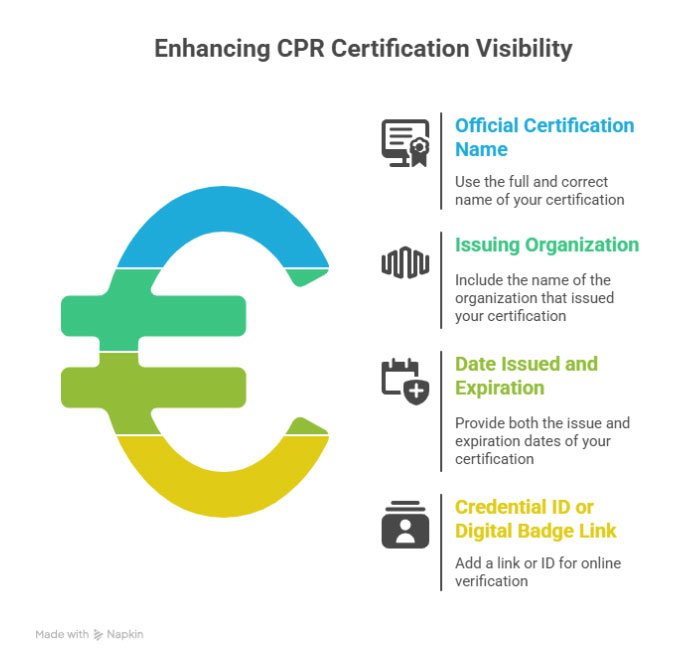
Official certification name

Use the full and correct name of your certification. For example, write “CPR/AED for Professional Rescuers and Healthcare Providers” instead of “CPR certified.” This helps employers understand exactly what level of training you’ve completed. Avoid abbreviations unless they are standard and widely recognized. A clear certification name adds credibility and ensures your resume meets job posting requirements or applicant tracking system (ATS) searches.

Issuing organization

Always include the name of the organization that issued your certification. Employers look for recognized names like the American Heart Association, American Red Cross, or the National Safety Council. Listing the organization shows that your training meets established industry standards. This detail also helps hiring teams verify your credentials quickly during the screening process, especially for roles requiring certification by policy or regulation.

Date issued and expiration

Include both the date you received your CPR certification and its expiration date. Most certifications are valid for two years, so employers want to confirm that your training is current and still valid. Use a format like “Issued: March 2024 | Expires: March 2026.” Keeping this information updated on your resume shows professionalism and attention to detail, both valuable in emergency response roles.

Credential ID or digital badge link

Some certifying bodies provide a Credential ID or a digital badge link for online verification. If available, include it beneath the certification entry. This helps employers confirm your status quickly and may be required for specific roles or background checks. Adding a digital badge link demonstrates that you’re comfortable with modern credentialing tools, which is a plus in digitally integrated workplaces.

Sample Resume Entries

Seeing how to list CPR certification in real resume examples can help you format your entry accurately and professionally. The proper presentation depends on the type of job you’re applying for. Below are two examples—one for a healthcare role where CPR is essential and one for a non-medical role that still adds value. Use these samples as templates to guide your formatting and placement choices.

For healthcare roles

In healthcare, CPR certification is often a basic requirement. It’s important to highlight it prominently and include all key details to ensure it meets employer screening. Here’s a sample entry:

Certifications

  • Basic Life Support (BLS) Certificate for Healthcare professionals– CPR and AED
  • American Heart Association
  • Issued: February 2024 | Expires: February 2026
  • Credential ID: AHA-CPR-456789

Professional Summary

Compassionate and licensed Registered Nurse with more than five years of experience in emergency and intensive care settings. CPR and BLS are certified by the American Heart Association and have up-to-date training in advanced airway management and automated external defibrillator (AED) use.

Skills

  • CPR and AED certified
  • Emergency response and triage
  • Patient safety and monitoring

In healthcare resumes, include CPR certification in the Certifications section and Professional Summary to reinforce your qualifications. Adding it under Skills or relevant job experience (if you’ve applied it on the job) can further demonstrate your real-world readiness and training. This complete approach helps hiring managers quickly confirm your credentials for patient-facing roles.

For non-medical roles

While not always required, CPR certification can set you apart in non-medical positions such as childcare, fitness instruction, teaching, security, and customer service. Here’s how you might list it:

Certifications

  • Adult and Pediatric First Aid/CPR/AED
  • American Red Cross
  • Issued: May 2023 | Expires: May 2025

Professional Summary

An energetic and responsible elementary school teacher firmly committed to student safety and well-being. Trained in CPR and obtained First Aid certification offered by the American Red Cross. Skilled in classroom management, conflict resolution, and emergency preparedness.

Skills

  • CPR and First Aid certified
  • Classroom safety practices
  • Crisis intervention

For non-medical roles, CPR certification shows your commitment to safety and your ability to respond in emergencies. While it may not be required, listing it can make you a lucrative candidate, especially in roles involving responsibility for children, the public, or high-traffic environments. Position the certification in a visible place and tailor the surrounding resume content to reinforce its relevance.

Common Mistakes to Avoid

Minor errors when listing CPR certification on your resume can reduce the impact of your qualifications or even create confusion for employers. Watch out for these common mistakes to ensure your resume looks polished and professional.

Using vague or incorrect certification names

Avoid writing generic terms like “CPR certified” without including the full certification title. Instead, be specific: use names such as Basic Life Support (BLS) for Healthcare Providers or Adult and Pediatric First Aid/CPR/AED. This helps employers understand the level and scope of your training.

Omitting the issuing organization

Not naming the certifying organization is a common oversight. Employers want to verify that your training came from a reputable source like the American Heart Association or American Red Cross. Leaving this out can make your certification look incomplete or unverified.

Not including dates

Leaving off the issue and expiration dates can raise red flags. Most CPR certifications expire after two years, and employers need to know that your training is current. Always include both dates in a clear format like “Issued: June 2023 | Expires: June 2025.”

Placing it in the wrong section

While it may seem minor, poor placement can reduce the visibility of your CPR certification. Avoid burying it in unrelated sections. Depending on your experience, use a dedicated Certifications section or place it within your Professional Summary, Skills, or Education.

Failing to update expired certifications

Listing expired or outdated credentials can hurt your credibility. Keep your resume current by removing expired certifications or renewing your training before including it.

FAQs

How do you put CPR certification on a resume?

Include it in a dedicated Certifications section using a consistent format: Certification Name, Issuing Organization, Date Issued–Expiration Date. For example: Adult and Pediatric First Aid/CPR/AED, American Red Cross, Oct 2023–Oct 2025. This format ensures clarity and makes verification easy for employers.

What is the fancy way to say CPR certified?

Use the official certification title instead of just saying “CPR certified.” For example, write Basic Life Support (BLS) Provider – American Heart Association or Heartsaver® CPR AED – AHA. These formal titles reflect specific training levels and look more professional on a resume.

How do you describe CPR certification?

In your summary or cover letter, highlight your CPR certification as a sign of emergency-response readiness. For example, Current CPR/AED certification from the American Red Cross ensures preparedness for medical emergencies and promotes workplace safety. This emphasizes your ability to act in critical situations.

How do you cite CPR certification on a resume?

Use a clear, professional citation format. Example: Basic Life Support (BLS) for Healthcare Providers, American Heart Association, Valid Nov 2023–Nov 2025. This shows the certification type, issuing body, and validity period, which helps employers verify your qualifications quickly.

Should I renew my CPR certification before applying?

Yes, renewing your CPR certification before applying is recommended, especially if the job requires it. Most certifications are valid for two years, and employers often look for candidates with current, verifiable credentials. An expired certification may signal you’re not fully prepared for emergencies. Renewing shows initiative and professionalism, giving you a competitive edge in roles where safety and emergency readiness matter. If your certification is close to expiring, complete a renewal course promptly so you can include up-to-date information on your resume without delay or concern during the hiring process.

Can I list in-progress or expired certifications?

You can list in-progress certifications, but be sure to label them clearly. For example: CPR Certification – In Progress (Expected August 2025). This shows employers that you’re actively working to meet job qualifications. Avoid listing expired certifications unless you’re in the process of renewal, and even then, it should be noted as Renewal in Progress. Listing an outdated credential without clarification may mislead employers or raise questions about your current preparedness. Always aim for transparency and accuracy when presenting your qualifications on a resume.

Online vs. in-person certification

Employers generally accept online and in-person CPR certifications, but in-person or blended (online + in-person skills check) formats are often preferred—especially in healthcare and childcare settings. In-person training ensures hands-on practice and better skill retention, which is critical in emergencies. Fully online courses may be viewed as less rigorous unless well-known organizations like the American Heart Association or the Red Cross provide them. Always choose a recognized provider and indicate the certification type on your resume to ensure employer confidence.

Pregnant Woman CPR: The Vital Technique That Could Save Two Lives

Pregnant Woman CPR: The Vital Technique That Could Save Two Lives

Performing CPR on a pregnant woman is a critical skill that could save two lives—the mother and her unborn child. Cardiac arrest during pregnancy, although rare, requires immediate action with specialized techniques to ensure the best possible outcome. Knowing how to perform CPR for pregnant women is essential for bystanders, medical professionals, and even family members, as the standard approach may not be practical due to physiological changes during pregnancy. These changes include an increased heart rate, lifted diaphragm, and pressure on major blood vessels from the growing uterus. Appropriately modified CPR increases the chances of survival and reduces potential complications. Understanding these unique considerations can make the difference between life and death. By learning the correct techniques, you can act swiftly and confidently in an emergency. Your knowledge could be the deciding factor that saves two lives.

Understanding CPR and Its Importance

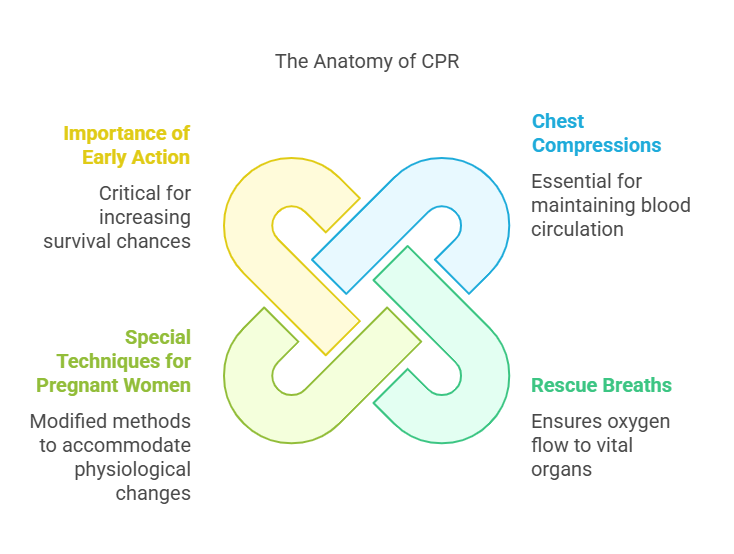
Cardiopulmonary resuscitation (CPR) is used during cardiac emergencies when the heart stops beating. It involves chest compressions and rescue breaths such that blood circulation is consistent and oxygen flow to vital organs, especially the brain. Otherwise brain damage can occur within minutes, making CPR a critical first aid measure. Studies show that early CPR doubles or triples the chances of survival after cardiac arrest. CPR preserves organ function by maintaining blood flow until advanced medical care is available. CPR is crucial not only for adults but also for special populations, including pregnant women, where modified techniques are necessary. Knowing how to perform CPR ensures you are prepared to help in emergencies at home, work, or public places. It empowers you to make a life-saving difference when seconds count.

Why Pregnant Women Need Special CPR Techniques?

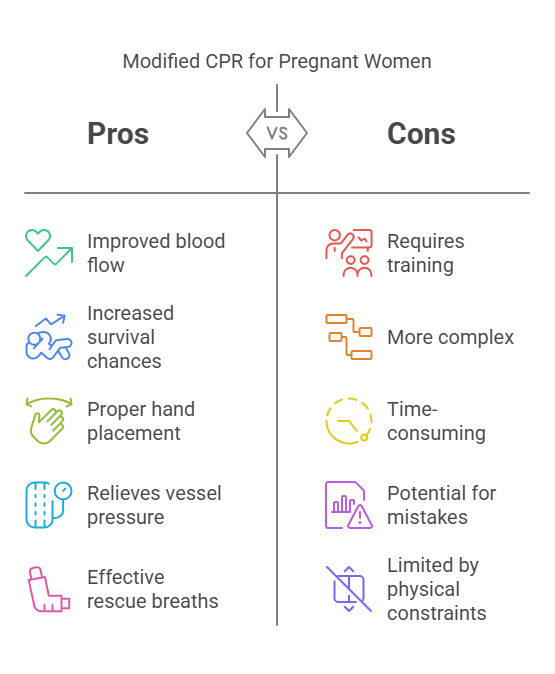
CPR for pregnant women requires unique modifications due to physiological changes during pregnancy. As the uterus expands, it can compress major blood vessels, minimizing blood flow to vital organs and affecting the effectiveness of standard chest compressions. Additionally, the lifted diaphragm may impact lung capacity, influencing the delivery of rescue breaths. If standard CPR is used, it may not generate enough circulation to sustain both the mother and the fetus. To counteract these challenges, rescuers should perform a left uterine displacement by gently pushing the uterus to the left side. This relieves pressure on the blood vessels and improves blood flow. Proper hand placement for chest compressions is also crucial, slightly higher than usual due to the shifted internal anatomy. Using these specialized techniques significantly increases the chances of survival for both the mother and her baby. SUMMARY: CPR for pregnant women requires special modifications due to physiological changes like pressure from the growing uterus. Adjustments such as left uterine displacement and proper chest compression placement are essential for increasing survival chances for both mother and baby. Learning these techniques can save two lives in an emergency.

Recognizing a Pregnant Woman in Cardiac Arrest

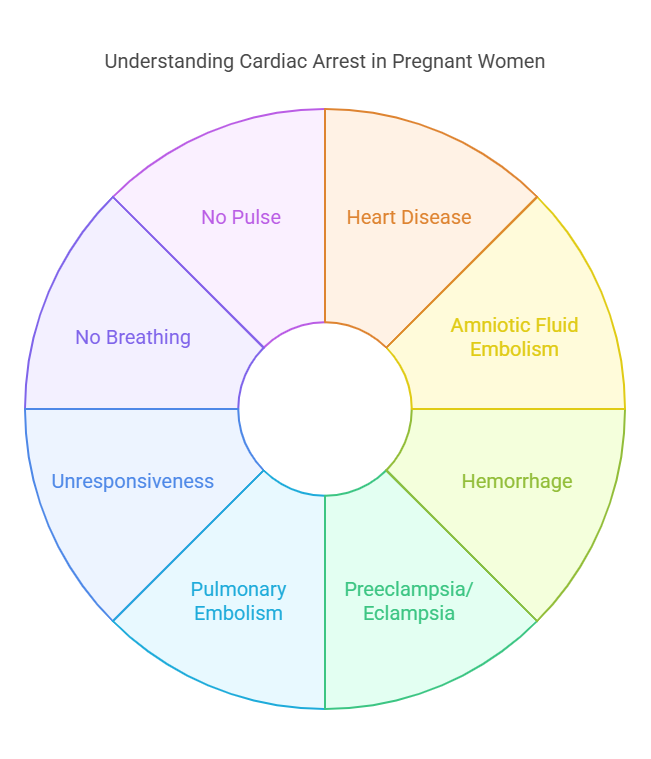
To provide effective CPR on a pregnant woman, it is vital to recognize the signs of cardiac arrest quickly. The most common causes of cardiac arrest during pregnancy include:
  • Heart disease: Pre-existing conditions or pregnancy-induced cardiovascular changes.
  • Amniotic fluid embolism: It is a rare but serious complication where amniotic fluid enters the bloodstream.
  • Hemorrhage: Severe blood loss from complications such as placenta previa or placental abruption.
  • Preeclampsia or eclampsia: High blood pressure disorders leading to seizures or stroke.
  • Pulmonary embolism: When a blood clot hampers blood flow to the lungs, it is termed as such.

Signs to Look For

  • Unresponsiveness: The woman does not respond to touch or sound.
  • No breathing or abnormal breathing: Gasping or complete absence of breath.
  • No pulse: Check the carotid pulse on the neck.
  • Cyanosis: Bluish discoloration of lips and fingertips due to lack of oxygen.
Immediate action is crucial. If a pregnant woman shows these signs, call emergency services immediately and begin modified CPR techniques, including left uterine displacement and chest compressions slightly above the usual spot. Recognizing and responding to these symptoms promptly increases the likelihood of survival for both mother and baby. Step-by-Step Guide to Performing CPR on a Pregnant Woman The following are the steps to perform CPR on a pregnant woman correctly:
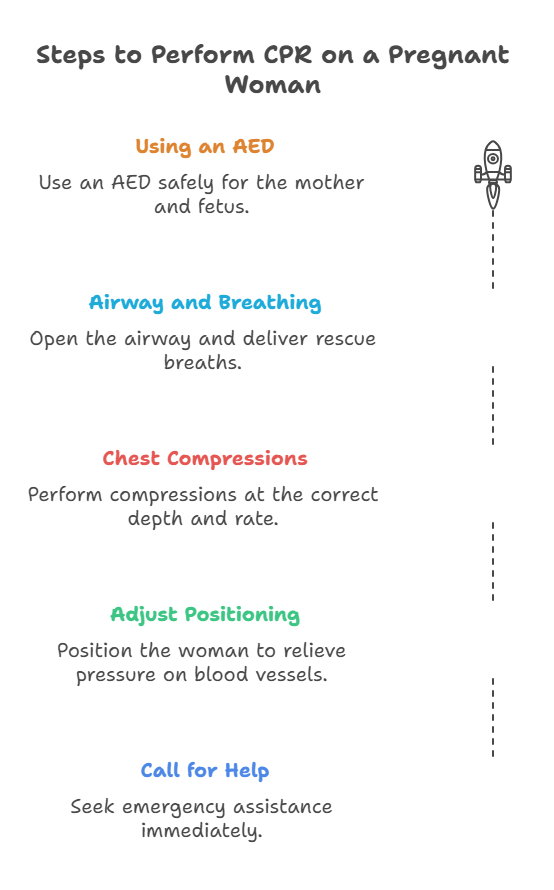
1. Call for emergency help

The first step in performing pregnant woman CPR is seeking emergency medical assistance immediately. Inform the dispatcher about the pregnancy, as specialized medical care will be required. If others are present, delegate someone to call while you begin CPR. Rapid emergency response increases the chances of survival for both the mother and baby.

2. Adjust the positioning

Proper positioning is crucial when performing CPR on a pregnant woman. The recommended CPR pregnant woman position involves a left uterine displacement to relieve pressure on major blood vessels. This is done by gently pushing the uterus to the left side or placing a rolled towel under the woman’s right hip, tilting her body 15 to 30 degrees. This adjustment improves blood flow and uplifts the effectiveness of chest compressions.

3. Chest compressions

For chest compressions, place your hands slightly higher on the breastbone than usual due to the upward shift of internal organs during pregnancy. Push hard and fast at 100 to 120 compressions per minute, with a depth of about two inches. Allow complete chest recoil between compressions to maximize circulation.

4. Airway and breathing

Open the airway through head-tilt, chin-lift method. Deliver two rescue breaths at a regular interval of 30 chest compressions. Ensure each breath makes the chest rise visibly. If the airway is obstructed, consider the possibility of aspiration and take appropriate measures to clear it.

5. Using an AED

If available, use an AED immediately. AEDs are safe for pregnant women and do not harm the fetus. Attach the pads as instructed, ensuring they avoid breast tissue. Continue CPR until medical professionals arrive. Knowing how to do CPR on a pregnant woman can be life-saving in critical situations. SUMMARY: Recognize cardiac arrest in pregnancy by unresponsiveness, no pulse, and cyanosis. Perform CPR with left uterine tilt, chest compressions slightly higher, and rescue breaths. Use an AED if available and call emergency services immediately

Modifications to Traditional CPR for Pregnant Women

There are several adjustments to traditional methods which are required when performing CPR on pregnant women:

Adjusting hand placement

When performing CPR on pregnant women, it is essential to adjust hand placement for chest compressions. Due to the upward shift of internal organs caused by the growing uterus, hands should be placed slightly higher on the breastbone than the standard position. This adjustment ensures effective compressions that maintain blood circulation for the mother and baby.

Importance of left lateral tilt

One of the most critical modifications is the CPR pregnant woman position, the left lateral tilt. This involves tilting the pregnant woman about 15 to 30 degrees to the left. It can be achieved by placing a rolled towel or a similar object under her right hip. This tilt reduces pressure on the inferior vena cava, a major blood vessel that supplies blood to the heart. Without this adjustment, blood flow may be compromised, decreasing the effectiveness of chest compressions. SUMMARY: Adjust hand placement slightly higher on the breastbone due to organ shifts. Use a left lateral tilt (15-30 degrees) by placing a towel under the right hip to relieve pressure on major blood vessels and improve circulation.

Dealing with obstruction risks

Pregnant women are at a higher risk of airway obstruction due to increased abdominal pressure and the possibility of aspiration. It is crucial to assess and clear any obstructions quickly. When delivering rescue breaths, avoid excessive ventilation, as it may increase the risk of aspiration.

The Role of AED in Saving Pregnant Women

Let us learn how AED is crucial in saving pregnant women through correct usage:

How to use an AED safely

An Automated External Defibrillator (AED) is a crucial device for resuscitating a pregnant woman experiencing cardiac arrest. AEDs are safe to use on pregnant women and do not harm the fetus. When using an AED, place the pads as instructed, typically on the upper right chest and lower left side, avoiding breast tissue. Dry the chest thoroughly to ensure proper pad adhesion and effective shock delivery if the chest is wet. Continue performing pregnant woman CPR between shocks as advised by the AED prompts.

Considerations for Shock Delivery

AEDs analyze the heart’s rhythm and deliver a shock only if necessary. In pregnant women, the priority is to restore maternal circulation, which indirectly benefits the fetus by maintaining placental blood flow. It is crucial not to delay defibrillation, as each minute without intervention decreases survival chances significantly. The electrical shock will unlikely affect the fetus, as the amniotic fluid acts as an insulator.

Ongoing care and monitoring

Right after shock delivery, immediately resume chest compressions. Ensure the CPR pregnant woman position is maintained with a left lateral tilt to optimize blood flow. Continue the cycle of compressions and shocks until advanced medical help arrives. Using an AED effectively, combined with proper CPR techniques, increases the chances of survival for both the mother and baby. Understanding how to do CPR on a pregnant woman with an AED is vital for anyone assisting in such emergencies. SUMMARY: Clear airway obstructions promptly and avoid excessive ventilation. AEDs are safe for pregnant women—place pads correctly, dry the chest, and continue CPR between shocks. Prioritize restoring maternal circulation, resume compressions immediately after shock, and maintain a left lateral tilt for optimal blood flow.

Common Myths and Misconceptions About Pregnant CPR

One common myth about CPR for pregnant women is that it harms the baby. However, CPR is crucial for both the mother and the fetus during emergencies. The primary concern is to restore circulation and oxygen to the heart and brain, which benefits both. Another misconception is that automated external defibrillators (AEDs) shouldn’t be used on pregnant women. This is false- AEDs are safe to use during pregnancy, and their use can be lifesaving. Debugging these myths ensures bystanders act confidently and correctly in emergencies.

Emergency Response: What Bystanders Need to Know

When witnessing a pregnant woman collapse, bystanders must act quickly. Call emergency services immediately and begin CPR without hesitation. Early action is crucial in improving outcomes for both the mother and the fetus. Bystanders are legally protected from liability in many regions under Good Samaritan laws when providing emergency assistance in good faith. It’s essential to perform CPR and use an AED if available. Every second counts and proper immediate action can save lives, reducing the risk of long-term complications for both mother and baby.

CPR for Pregnant Women vs. Standard CPR: Key Differences

CPR for pregnant women involves some key modifications to standard CPR techniques. The primary difference is that you should position the hands higher on the sternum when performing chest compressions and provide extra support. If the pregnancy is in later stages, tilting the woman slightly to the left can reduce pressure on the vena cava. In addition, when giving breaths, ensure the airway is open and transparent, as pregnancy can complicate airway management. Always remember that performing CPR correctly and quickly remains the priority.

Complications and Risks of CPR During Pregnancy

CPR during pregnancy can pose some risks, including potential injury to the mother and fetus. Chest compressions may cause rib fractures, particularly in the later stages of pregnancy, but the necessity of restoring circulation often outweighs these injuries. Fetal distress may also occur if the blood flow to the placenta is interrupted. However, the CPR benefits outweigh the risks in cases of cardiac arrest. Immediate intervention is crucial for both the mother’s and the baby’s survival, as delays in care can lead to irreversible harm or death.

Post-Resuscitation Care for Pregnant Women

After successful resuscitation of a pregnant woman, she will require intensive monitoring in a hospital setting. The mother’s vital signs must be stabilized, and fetal monitoring is crucial to assess the baby’s well-being. Doctors will determine potential complications, such as uterine rupture or hemorrhage, and ensure proper circulation. In some cases, an emergency cesarean section may be necessary to protect the fetus if the mother’s condition remains unstable. Continuous observation of both the mother and fetus will help guide further care decisions, aiming to stabilize both in the best possible condition.

Training and Certification for Pregnant Woman CPR

Proper training in CPR for pregnant women is essential for those who might encounter such emergencies. Many organizations, such as the American Heart Association (AHA) and Red Cross, offer specialized CPR courses that cover the unique needs of pregnant women. These courses teach techniques for performing CPR safely on pregnant individuals and using AEDs appropriately. Certification ensures that first responders, caregivers, and bystanders know how to respond confidently during a cardiac emergency. This training is critical in improving outcomes for the mother and baby in emergencies. SUMMARY: CPR and AEDs are safe and lifesaving. Act immediately—call for help, start CPR, and use an AED. Adjust compressions and tilt left if needed. Risks exist but are outweighed by the benefits. Post-resuscitation monitoring is crucial, and proper training improves survival chances.

FAQ:

Can CPR harm the baby during resuscitation?

CPR may pose some risks, like rib fractures, but the benefits of restoring circulation to both the mother and fetus outweigh these potential injuries. Immediate resuscitation is essential to save both lives, as delays in CPR can result in more severe harm to both the mother and baby.

What is the most essential modification when giving CPR to a pregnant woman?

The most significant modification is to tilt the pregnant woman slightly to the left to reduce pressure on the vena cava, improving blood flow. Additionally, ensure you perform chest compressions higher on the sternum and adjust your hand placement to accommodate the pregnancy.

Can I use an AED on a pregnant woman?

Yes, an AED is useful for pregnant woman. The device functions the same way, regardless of pregnancy, and can be life-saving for both the mother and the baby. There is no harm in using an AED during pregnancy if necessary.

What are the leading causes of cardiac arrest in pregnant women?

The leading causes of cardiac arrest in pregnant women include complications like hemorrhage, preeclampsia, heart disease, and pulmonary embolism. These conditions can lead to severe complications, affecting both the mother and baby. Prompt intervention and CPR are essential in improving survival rates.

Should I perform mouth-to-mouth resuscitation on a pregnant woman?

Yes, mouth-to-mouth resuscitation should be performed on a pregnant woman in case they are not breathing. The technique is the same as for non-pregnant individuals. However, if available, mouth-to-mask or bag-valve resuscitation is preferred as it may be more effective and safer.

Do I need special CPR training to help a pregnant woman?

While basic CPR training applies, special training for pregnant women is beneficial. This training covers key differences, such as positioning, hand placement, and using AEDs safely. It ensures proper technique and understanding of the risks and benefits, improving outcomes for both the mother and the fetus. Summing Up Performing CPR on a pregnant woman requires careful attention to ensure both the mother’s and baby’s safety. While there are some modifications, such as tilting the woman to the left and adjusting hand placement, the key goal remains the same—restoring life-saving circulation. Bystanders must act swiftly and confidently, knowing that using an AED and performing CPR can save both lives. The risks, such as potential injury to the mother, are far outweighed by the immediate need for resuscitation. Proper training in pregnant CPR is essential to respond effectively in emergencies. Take the first step today- enroll in a Simple CPR course to get the training you need to save lives confidently. Learn CPR for pregnant women and other life-saving techniques with expert instruction.

When Should the Rescuer Clear the Victim? Life-Saving Timing Explained

Knowing when the rescuer should clear the victim is crucial for effective and safe CPR. Clearing the victim means ensuring no one is in contact with them before delivering a shock from an automated external defibrillator (AED). This step protects bystanders from accidental shocks and maximizes the effectiveness of the AED. Timing is everything in emergencies; understanding when to clear the victim can be the difference between life and death. This article will explain the critical moments when a rescuer should clear the victim, including before analyzing the heart rhythm and before delivering a shock. It will also cover common mistakes to avoid and tips for ensuring everyone’s safety during the resuscitation process. Knowing the right timing helps rescuers act confidently and effectively. We encourage readers to engage in comments or share this post to help spread awareness on this crucial topic.

Understanding the Role of a Rescuer

A rescuer plays a vital role in emergencies by providing immediate help to someone in distress. Whether performing CPR, using an automated external defibrillator (AED), or calling for medical assistance, the rescuer’s quick actions can save lives. Knowing when the rescuer should clear the victim is essential to this responsibility, ensuring safety while delivering life-saving care. The rescuer must stay calm, assess the situation, and act swiftly. By understanding their role and following proper procedures, rescuers can make a significant difference in critical moments, increasing the chances of survival for the victim.

What Does It Mean to “Clear the Victim”?

To clear the victim means ensuring that no one, including the rescuer, is touching the victim when delivering a shock using an automated external defibrillator (AED). This step is crucial to prevent accidental shocks to bystanders and to ensure the AED works effectively. But when should the rescuer clear the victim? The rescuer must clear the victim before analyzing the heart rhythm and again before delivering a shock. Shouting “Clear!” ensures everyone steps back. Knowing the right moments to clear the victim keeps the scene safe and increases the chances of a successful resuscitation.

Scenarios That Require Clearing the Victim

Knowing when the rescuer should clear the victim is essential to safely and effectively use an automated external defibrillator (AED). Here are common scenarios that require removing the victim:

  • Before Analyzing the Heart Rhythm: The AED analyzes the heart rhythm of the victim to determine if a shock is needed. Any movement or contact can interfere with the reading during this process, leading to inaccurate results. The rescuer must ensure no one is touching the victim at this stage.
  • Before Delivering a Shock: This is the most critical moment to clear the victim. Touching the victim during the shock can transfer the electrical current to others, posing serious safety risks. Shouting “Clear!” before pressing the shock button alerts bystanders to step back.
  • During High-Stress Situations:

    In chaotic environments, it is easy for bystanders to crowd around. The rescuer must remain vigilant and clear the area before using the AED.

    When Multiple Rescuers are Involved, Coordination is essential. One rescuer should ensure everyone is clear before the AED analyzes or delivers a shock.

By understanding these scenarios, rescuers can act confidently and safely, maximizing the AED’s effectiveness.

Scenarios That Require Clearing the Victim

The Importance of AEDs in Rescue Situations

Automated external defibrillators (AEDs) are crucial in saving lives during cardiac emergencies. They are designed to analyze heart rhythms and deliver a shock that can restart the normal heartbeat. Understanding when the rescuer should clear the victim is vital for using AEDs effectively. Here’s why AEDs are so important:

  • Immediate Response Saves Lives: Cardiac arrest victims need immediate care. Using an AED within minutes significantly increases survival rates. Knowing when to clear the victim ensures the shock is delivered safely and effectively.
  • Guided Instructions for Rescuers: AEDs provide step-by-step voice prompts, guiding rescuers through the process. This feature is helpful, especially for those with limited training. However, the rescuer must pay close attention to instructions about clearing the victim to avoid accidental shocks.
  • Better CPR Efforts: AEDs are most effective when combined with high-quality CPR. The rescuer should perform CPR between shocks, but they must clear the victim before each analysis and shock delivery.
  • Accessible and Easy to Use: AEDs are designed for public use and are commonly found in schools, airports, and workplaces. With basic knowledge of when the rescuer should clear the victim, bystanders can confidently use AEDs to help save lives.

The Importance of AEDs in Rescue Situations

How to Use an AED?

An automated external defibrillator (AED) can save a life during a cardiac emergency. Knowing when the rescuer should clear the victim is crucial for safe and effective use. Here’s how to use an AED:

  • Turn on the AED: Power on the device. It will provide voice prompts to guide you through each step.
  • Attach the Pads: Place the pads on the victim’s bare chest as shown in the AED’s diagrams. One pad get placed on upper right chest, and the other on the lower left side.
  • Clear the Victim Before Analysis: Ensure no one touches the victim before the AED analyzes the heart rhythm. This prevents inaccurate readings.
  • Follow AED Instructions: If a shock is advised, the AED will prompt you to clear the victim again. Loudly announce “Clear!” to ensure no one is in contact.
  • Press the Shock Button: Press the shock button once the area is clear. After the shock, continue CPR as instructed by the AED.

Step-by-Step Guide to Clearing the Victim

Clearing the victim is a critical safety step when using an automated external defibrillator (AED). Knowing when the rescuer should clear the victim prevents accidental shocks and ensures accurate heart rhythm analysis. Here’s a step-by-step guide:

Before Analyzing Heart Rhythm:

  • Ensure no one touches the victim before pressing the “analyze” button on the AED.
  • Loudly announce, “Clear!” to alert bystanders.
  • Visually check that everyone is standing back.

Before Delivering a Shock:

  • After the AED advises a shock, double-check that no one is in contact with the victim.
  • Again, shout “Clear!” to warn others.
  • Confirm that the area is clear before pressing the shock button.

During High-Stress Situations:

  • Remain calm and assertive. Repeat “Clear!” as needed to ensure safety.
  • If multiple rescuers are present, one person should be responsible for clearing the area.

Common Mistakes Rescuers Make and How to Avoid Them

Even trained rescuers can make mistakes during high-stress emergencies. Knowing when the rescuer should clear the victim is vital for effective and safe AED use. Here are common mistakes and how to avoid them:

Not Clearing the Victim Properly

Mistake: Failing to ensure that no one is touching the victim before analyzing the heart rhythm or delivering a shock.

How to Avoid: Always shout “Clear!” loudly and double-check that no one is in contact with the victim. Visual confirmation is essential.

Improper Pad Placement

Mistake: Placing AED pads incorrectly can lead to ineffective shocks.

How to Avoid: Follow the AED’s diagrams carefully. One pad should go on the upper right chest and the other on the lower left side.

Hesitation or Panic

Mistake: Freezing under pressure or delaying AED use.

How to Avoid: Stay calm and follow the AED’s voice prompts. Practice and training can improve confidence.

Stopping CPR Too Long

Mistake: Interrupting chest compressions for too long while setting up the AED.

How to Avoid: Minimize interruptions by having another rescuer continue CPR until the AED is ready for analysis.

Common Mistakes Rescuers Make and How to Avoid Them

Legal and Ethical Considerations for Rescuers

Rescuers must be aware of legal and ethical responsibilities when providing emergency care. Understanding when the rescuer should clear the victim is just one part of safe and responsible rescue efforts. Here are the key considerations:

Good Samaritan Laws

Good Samaritan laws protect rescuers who provide emergency aid in good faith from legal liability. These laws encourage bystanders to help without fear of being sued. However, the rescuer must act within their training and avoid reckless behavior. Properly clearing the victim before using an AED is crucial for ensuring safety and complying with these laws.

Consent and Refusal of Care

Ethically, rescuers must seek consent from conscious victims before providing aid. In case of unconscious victim, consent is implied. However, if a Do Not Resuscitate (DNR) order is present, the rescuer must respect it, even in life-threatening situations.

Duty to Act

While most bystanders are not legally required to help, certain professionals, like healthcare workers, must act. If a rescuer chooses to assist, they must continue until relieved by a medical professional.

Proper Use of AEDs

Misuse of AEDs can result in legal consequences. To ensure safe and effective use, rescuers should follow all guidelines, including when to clear the victim

First Aid and CPR: The Connection to Clearing the Victim

First aid and CPR go hand in hand with knowing when the rescuer should clear the victim. Clearing the victim is crucial when using an automated external defibrillator (AED) during CPR. This step ensures the safety of bystanders and the effectiveness of the AED. During CPR, rescuers perform chest compressions to maintain blood flow. However, before the AED analyzes the heart rhythm or delivers a shock, the rescuer must clear the victim to prevent interference and accidental shocks. Understanding this connection allows rescuers to perform CPR safely and efficiently, maximizing the chances of survival.

What to Do After Clearing the Victim? Next Steps

After clearing the victim, the following steps are crucial for adequate resuscitation. Once the area is clear, allow the automated external defibrillator to understand heart rhythm without interruption. If the AED advises a shock, double-check that no one is touching the victim before pressing the shock button. Immediately after delivering the shock, resume CPR with chest compressions and rescue breaths as instructed by the AED. Continue this cycle of CPR and AED use until ER professionals arrive or the victim begins to recover. Knowing when the rescuer should clear the victim ensures safety and improves survival chances.

Safety Measures to Follow During a Rescue

Safety is a top priority during any rescue operation. Knowing when the rescuer should clear the victim is essential for preventing accidents and ensuring effective aid. Here are key safety measures to follow:

  • Assess the Scene: Make sure the area is clean before approaching the victim. Look for hazards like fire, electrical wires, or traffic. Only proceed if it is safe; otherwise, call emergency services for assistance.
  • Use Protective Equipment: Use gloves and a mask to stay safe from bodily fluids if available. Use a rescue mask or shield when performing rescue breaths.
  • Clear the Victim When Using an AED: Announce “Clear!” loudly before analyzing the heart rhythm and delivering a shock. Visually confirm that no one is in contact with the victim.
  • Stay Calm and Focused: Keep bystanders back and maintain a clear working area. Stay composed and follow the AED’s voice prompts and CPR guidelines.

Myths and Misconceptions About Rescuing Techniques

There are many myths and misconceptions about rescuing techniques that can lead to hesitation or mistakes during emergencies. One common misconception is that only trained professionals can use an automated external defibrillator (AED). In reality, AEDs are suitable for public use and provide clear voice prompts, making them safe and effective for bystanders to operate. Another myth is that CPR can restart a stopped heart. CPR maintains blood flow but does not restart the heart- only an AED can deliver the shock needed to restore a normal rhythm.

Additionally, some believe it’s safe to touch the victim during AED use. However, knowing when the rescuer should clear the victim is crucial to avoid accidental shocks. Finally, people often fear causing harm by performing CPR incorrectly, but doing something is better than doing nothing. Understanding the facts helps rescuers act confidently and save lives.

Myths and Misconceptions About Rescuing Techniques

FAQ:

Why is clearing the victim important?

Clearing the victim ensures no one is in contact before delivering a shock with an AED, preventing accidental shocks to bystanders. It also guarantees accurate heart rhythm analysis for adequate resuscitation.

What happens if someone is touching the victim during a shock?

Anyone touching the victim could receive an electric shock, posing serious safety risks. It can also interfere with the AED’s effectiveness.

Can I use an AED on a wet surface?

Yes, but make sure the victim’s chest is dry before applying the AED pads. Standing water should be avoided to ensure safety.

Should I perform CPR before or after using an AED?

Start CPR immediately and use the AED as soon as it is available. Continue CPR between shocks as instructed by the AED.

How loud should I announce “clear”?

Announce “Clear!” loudly to ensure everyone returns before analysis and shock delivery. Double-check the area visually.

Can an untrained person use an AED?

Yes, AEDs are designed for public use and provide step-by-step voice prompts. However, proper training uplifts confidence and effectiveness.

Wrapping Up

Knowing when to clear the victim is essential for the safe and effective use of an automated external defibrillator (AED). By understanding the right timing and following proper procedures, rescuers can protect bystanders and maximize the AED’s effectiveness. Being prepared makes all the difference in an emergency, from recognizing critical moments to avoiding common mistakes. By staying informed and confident, rescuers can save lives.

At Simple CPR, we are dedicated to empowering individuals with life-saving skills. Visit our website to check out our certified CPR and AED training courses. Get trained today and be ready to make a difference!