




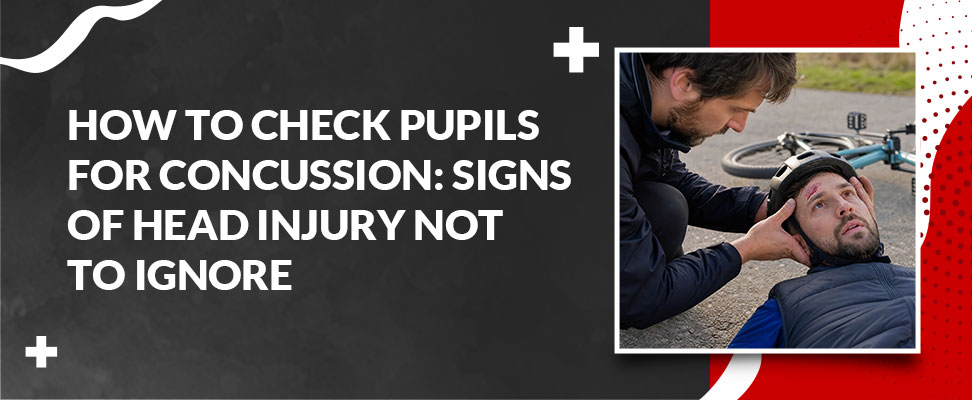
Head-Injury Warning Signs in First Aid: What Pupil Checks Can and Cannot Tell You
A pupil check can be a useful observation after a bump, blow, or jolt to the head. It is not a concussion test, and normal-looking pupils do not rule out a concussion or another serious injury. First aid starts with the person’s overall condition, not a focused eye exam.
Key Takeaway
- Checking pupils after a head injury can help identify warning signs of a concussion or serious brain injury. Watch for unequal pupils, vision changes, confusion, or worsening headaches. Pupil checks cannot rule out a concussion, so seek emergency medical care for unequal pupils or other serious symptoms./li>
If someone has a new difference in pupil size after a head injury, or shows any emergency warning sign, call 911 or have them taken to an emergency department right away.
Put first-aid priorities ahead of a pupil check
Scene safety, responsiveness, breathing, and life-threatening bleeding come first. Do not delay those checks to look at a person’s pupils.
If the area is safe, get help and assess the person’s condition. A person who is unresponsive, not breathing normally, or has severe bleeding needs immediate emergency action based on your training and dispatcher instructions. After a head injury, avoid unnecessary movement, especially of the head and neck, while you wait for professional help.
Once urgent threats have been addressed, continue watching the person. Note changes in alertness, breathing, behavior, speech, balance, or symptoms. This broad observation is more useful to emergency responders than repeatedly checking one sign.
A pupil observation does not diagnose or rule out concussion
Concussion symptoms can affect how someone feels, thinks, acts, sleeps, or moves. They may appear immediately or develop over the following hours or days. A person can have a concussion with pupils that look equal and react normally to light.
Watch for symptoms such as headache, dizziness, nausea, balance problems, sensitivity to light or noise, vision problems, trouble concentrating, memory problems, confusion, irritability, unusual fatigue, or changes in sleep. The person should stop the activity that led to the injury and be evaluated by a healthcare professional.
Pupil size can also vary for reasons unrelated to a head injury. Some people naturally have pupils that are slightly different in size. In a first-aid setting, the concern is a difference that is new after an injury, particularly when it occurs with worsening symptoms or altered consciousness.
Unequal pupils and other head-injury danger signs
A new pupil that is noticeably larger than the other after a bump, blow, or jolt to the head is a medical emergency warning sign. Call 911 or seek emergency care immediately. Do not wait to see whether it improves, and do not rely on a pupil check to decide whether another serious symptom matters.
Emergency care is also needed when a person has any of the following after a head injury:
-
A headache that worsens or does not go away
-
Repeated vomiting
-
Weakness, numbness, or reduced coordination
-
Slurred speech, unusual behavior, increasing confusion, restlessness, or agitation
-
A seizure or convulsion
-
Trouble recognizing people or places
-
Loss of consciousness, extreme drowsiness, or inability to wake up
-
A child who will not stop crying, cannot be consoled, or will not nurse or eat
Stay with the person, monitor changes in breathing and responsiveness, and follow instructions from 911. Do not give food, drink, alcohol, or medication unless directed by a healthcare professional.
PEARL and PERRLA: useful clinical terms, not lay diagnostic tests
You may hear pupil-response terms in first-aid or clinical settings. PEARL is commonly used to mean “pupils equal and reactive to light.” PERRLA adds “round” and “accommodation,” referring to how the eyes adjust focus between near and distant objects.
These terms describe observations in a broader clinical assessment. They do not establish whether someone has a concussion, and a layperson does not need to perform a detailed PERRLA assessment before calling for help. In a suspected head injury, a brief comparison of both pupils may help you notice a concerning change, but it must never distract from emergency priorities or professional evaluation.
Avoid repeatedly shining a bright light into someone’s eyes or trying to interpret subtle differences. Tell responders what you saw, when you noticed it, and whether the change followed the injury.
What to observe and report after a possible concussion
A clear handoff can help emergency responders and healthcare professionals. If it is safe to do so, keep track of what happened and what changed afterward:
-
The time and mechanism of injury, such as a fall, collision, or blow to the head or body
-
Whether the person lost consciousness, seemed confused, or had memory gaps
-
Symptoms that began right away and symptoms that appeared later
-
Vomiting, seizure activity, worsening headache, speech changes, or trouble walking
-
Any new difference in pupil size or reaction that you observed
-
Medicines, allergies, and relevant medical information if known
Do not pressure the person to “walk it off” or return to play, work, driving, or other activity after a suspected concussion. A healthcare professional should guide the return to normal activities.
Why supervised first-aid training matters
Reading about head injuries can help you recognize important warning signs. It cannot replace practicing how to assess a scene, communicate with a 911 dispatcher, monitor a changing condition, and respond when someone becomes unresponsive.
Instructor-led, hands-on First Aid and CPR training gives learners the chance to practice skills, ask questions, and receive correction in real time. That supervised practice is especially valuable because head injuries can involve several competing concerns at once, including breathing, bleeding, possible spinal injury, and a person whose condition changes quickly.
SimpleCPR offers online First Aid and CPR training options, including courses that cover head-injury response as part of broader emergency preparedness. Before enrolling, confirm that the course format and certificate meet the requirements of your employer, school, licensing body, or local organization. [Add: verified link to any instructor-led or hands-on SimpleCPR option, if available.]
The practical takeaway
Pupil checks are one small part of observing someone after a head injury. They cannot confirm a concussion, and normal pupils cannot clear someone for activity or rule out a serious problem. Prioritize safety, responsiveness, breathing, and life-threatening conditions. Call 911 for a new unequal pupil or any other emergency warning sign, then keep monitoring the person until help arrives.
For everyday readiness, build on this information with First Aid and CPR education that includes supervised, hands-on practice when available. Explore SimpleCPR First Aid training and choose a course that fits your required training format.



QUICK Q&A
What does it mean if someone has unequal pupils after a head injury?
A new difference in pupil size after a head injury is a CDC danger sign that requires immediate emergency medical care. It may indicate bleeding or increased pressure inside the skull.
How do you check someone's pupils after a head injury?
Check the pupils in normal lighting, then briefly shine a small light into each eye. Both pupils should constrict quickly and respond similarly. If one pupil is noticeably larger or reacts differently, seek emergency medical care.
Can someone naturally have unequal pupils?
Yes. Some people have a harmless, lifelong difference in pupil size called physiologic anisocoria. The concern is when the difference appears for the first time after a head injury.
What are the CDC's danger signs after a head injury?
CDC danger signs include one pupil larger than the other, worsening headache, repeated vomiting, seizures, slurred speech, increasing confusion, weakness or numbness, difficulty waking up, and loss of consciousness. Any of these signs requires immediate emergency care.
Do normal-looking pupils rule out a concussion?
No. Many people with a concussion have normal pupils. Pupil size is only one part of the assessment, so watch for other concussion symptoms and danger signs as well.
When should you call 911 after a head injury?
Call 911 immediately if the person develops unequal pupils, loses consciousness, has repeated vomiting, seizures, slurred speech, increasing confusion, a worsening headache, or any other CDC danger sign after the injury.
Related Posts

Parents Tackle Goal of Teaching CPR to Thousands
The parents of 16-year-old Morgan Wilson are creating an CPR education organization after their daughter died of cardiac arrest. She collapsed while playing tennis and died in the hospital several days later. Her parents believe she would still be alive today if she had received CPR in time. So, in memory of their daughter, they […]

NCAA Amends CPR Rules
Style Snapshot The NCAA has updated its rules to require that a CPR-certified staff member must be present during physical countable athletic activities on campus. While it is not mandatory for coaches to be certified, it is encouraged to ensure safety during emergencies. This change empowers coaches to respond effectively in catastrophic situations. Surprisingly, college […]

Be A Hero! Learn CPR. – CPR Blog
Soccer season is upon us and it’s a good time to make sure you know CPR. With dozens of kids running their little hearts out in the heat, there’s no telling what kind of emergency could happen. Most youth organizations don’t require their volunteer coaches to be CPR certified, which is why parents really need […]
New Law Requires CPR Training in Illinois High Schools
Style Snapshot A new Illinois law requires high school students to receive CPR and defibrillator (AED) training before graduation. Inspired by families who lost children to on-campus cardiac emergencies, this legislation sets a precedent for other states. While students can opt out, the goal is to ensure every student understands how to respond in an […]
Seizure First Aid
If you have ever wondered what to do when someone is having a seizure or how to provide first aid for a seizure, you are not alone. Epilepsy, a tendency to have seizures that start in the brain, is relatively common worldwide. As common as this condition is, though, there is still little that can […]

CPR for Pregnant Women- Step-by-Step Guide to Safe Maternal Resuscitation
Maternal cardiac arrest is a rare but life-threatening emergency that requires immediate and specialized care. The incidence is approximately 1 in every 12,000 deliveries, according to the American Heart Association (AHA). While uncommon, this statistic highlights the critical need for healthcare providers and bystanders to be prepared. The most common causes include hemorrhage, cardiovascular disease, […]