



What Is Pronator Drift? FAST Stroke Assessment Method Explained
Maybe a nurse mentioned it during a hospital visit. Maybe you read it in a textbook, or heard it on a medical show, and now you are wondering what pronator drift actually means. Here is the short version. Pronator drift is a clinical test doctors and nurses use to catch subtle arm weakness, often as an early clue to stroke.
But if you are the kind of person who wants to know what to actually do when someone in front of you might be having a stroke, the term you need is not pronator drift. It is FAST. We will cover what pronator drift means, what it can point to, and then get you to the test that matters most if you are the one standing there when it counts.
Key Takeaway
- Pronator drift is a clinical neurological test used by healthcare professionals to detect subtle arm weakness that may indicate a stroke or other neurological condition. Bystanders should use the FAST test instead, checking for Face drooping, Arm weakness, Speech difficulty, and Time to call 911, to quickly recognize stroke symptoms and get emergency medical help without delay./li>
What Is Pronator Drift?
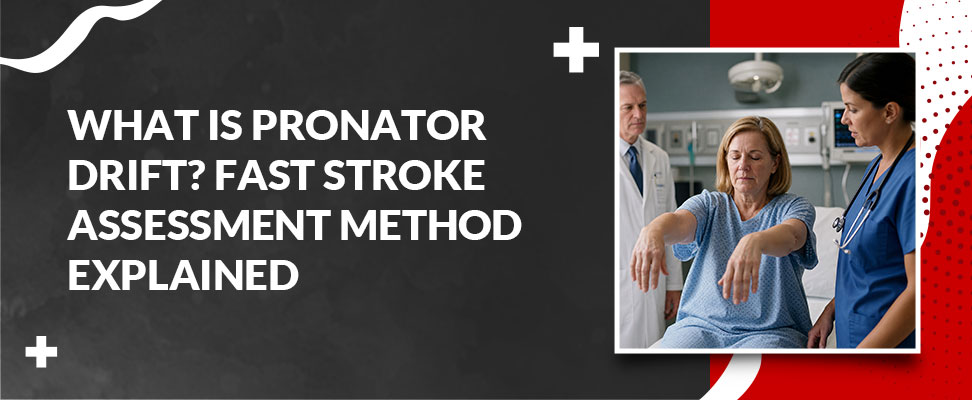
Pronator drift is a clinical neurological exam. The patient extends both arms straight out in front of them, parallel to the floor, with palms facing up, then closes their eyes and holds that position for 20 to 30 seconds while a clinician watches closely.
A positive result happens when one arm, or occasionally both, starts to drift downward while the palm rotates inward, or pronates. That inward turn is why the test carries the name it does. Even a small amount of drift or rotation counts as positive, which is exactly what makes this exam useful. It is built to catch weakness so mild that a standard strength test, where a clinician asks a patient to push or squeeze against resistance, might miss it entirely.
What Does a Positive Pronator Drift Mean?
A positive pronator drift points to a problem somewhere along the corticospinal tract, the pathway that carries movement signals from the brain down through the spinal cord to the muscles. When that pathway is disrupted, clinicians call it an upper motor neuron issue, and it tends to show up first as this kind of subtle, one-sided weakness.
The most common cause is stroke. Because of how the nervous system crosses over, a positive drift usually shows up on the side of the body opposite the affected side of the brain. A weak right arm, for example, often points to an issue on the left side of the brain.
Stroke is not the only explanation. Clinicians also use pronator drift to help evaluate multiple sclerosis, traumatic brain injury, brain tumors, and spinal cord lesions. On its own, a positive test is a sign, not a diagnosis. It tells a clinician where to look next, and it gets paired with the rest of the neurological exam, patient history, and often brain imaging before anyone concludes.
Who Performs This Test and Why It Is Not a Bystander Tool
Pronator drift is performed by trained medical personnel, typically a physician, nurse, or EMS provider, as one piece of a full neurological workup. That usually happens in an emergency department, a clinic, or during an inpatient exam, and it is almost always paired with other tests rather than read on its own.
Interpreting the result correctly takes clinical context. A clinician needs to know what a normal amount of sway looks like, how to rule out fatigue or an old injury as the cause, and how the finding fits with everything else they are seeing in the patient. That is not something a bystander witnessing a possible stroke can reasonably sort out in the moment, and trying to would eat up time that matters far more than the test itself.
If you work in a healthcare setting and want a deeper foundation in recognizing stroke and other emergencies as part of your professional certification, SimpleCPR's Healthcare Provider BLS Professional CPR course builds that skill set alongside CPR, AED use, and airway management. For a look at why that level of training matters beyond the classroom, our post on why BLS training is worth it walks through the real-world case for it.
What You Should Actually Know About the FAST Test
Here is the part that matters most if you are not a clinician. FAST is the test built for exactly this situation, and you already have everything you need to use it. No equipment, no training, no waiting for someone else to check. Just four quick things to look for.
-
Face drooping. Ask the person to smile. Does one side of the face droop or feel hard to move?
-
Arm weakness. Ask them to raise both arms. Does one arm drift downward or fail to hold steady?
-
Speech difficulty. Ask them to repeat a simple sentence. Is the speech slurred, or do they struggle to find the words?
-
Time to call 911. If you see any one of these signs, call 911 immediately and note the time symptoms started. That timestamp shapes which treatments are available, so do not guess at it later.
FAST is simple by design, because a stroke does not wait for you to feel ready. Knowing it cold, and knowing how to act once you have called for help, is exactly what SimpleCPR's online First Aid certification course is built to teach, alongside how to recognize other emergencies like heart attack and diabetic crises before professionals arrive.
Pronator Drift vs FAST, What Is the Difference
Both terms show up around stroke, but they serve completely different purposes and completely different people. Here is how they stack up.
|
Category |
Pronator Drift |
FAST |
|
Performed by |
Trained medical personnel |
Anyone, including bystanders |
|
Setting |
Clinical exam (ER, hospital, clinic) |
On the scene, immediately |
|
Requires |
Clinical training to interpret |
No training required |
|
Purpose |
Detailed neurological assessment |
Fast recognition and 911 activation |
|
When to use |
Part of a full medical workup |
The moment you suspect a stroke |
The table makes the split obvious. Pronator drift adds precision after help has already arrived. FAST is what gets help on the way in the first place, which is why it is the one worth committing to memory.
Know the Signs, Act Fast
Pronator drift is worth understanding, especially if a doctor or nurse ever mentions it to you or a loved one during care. But the test that actually puts you in a position to help is FAST, and it is built for someone with exactly zero medical background.
That recognition skill, along with how to respond once you have called 911, is exactly what SimpleCPR's certification courses are built around. Standard First Aid covers stroke, heart attack, seizures, and the other emergencies you hope you never see but should be ready for anyway. It runs 30 to 60 minutes, follows current AHA guidelines, and comes with a 100 percent money-back guarantee. Get certified for $19.95, print your card immediately, and be ready the next time it counts.
Want CPR skills covered in the same course? Adult CPR and First Aid bundles both into one certification, and for related symptom recognition, our post on heart discomfort after exercise breaks down when chest symptoms warrant a closer look.


QUICK Q&A
What is pronator drift?
Pronator drift is a clinical neurological test where a patient holds both arms out with palms up and eyes closed for 20 to 30 seconds. If one arm drifts downward and the palm turns inward, the result counts as positive, and it can point to weakness caused by an upper motor neuron issue such as stroke.
What does a positive pronator drift test mean?
A positive test means one arm drifted down and rotated inward, which suggests subtle weakness tied to upper motor neuron or corticospinal tract dysfunction. It is most often linked to stroke, showing up opposite the affected side of the brain, though it can also appear with multiple sclerosis, traumatic brain injury, or spinal cord lesions.
Can I check for pronator drift at home?
No. Pronator drift is a clinical exam meant to be performed and interpreted by trained medical staff as part of a full neurological workup. Trying it at home instead of recognizing stroke signs and calling 911 wastes time you do not have. If you suspect a stroke, run through FAST and call for help right away.
What is the FAST test for stroke?
FAST stands for Face drooping, Arm weakness, Speech difficulty, and Time to call 911. It is a simple screening method anyone can use, with no training required, to spot the most common stroke signs in seconds and get emergency help moving as quickly as possible.
What is the difference between pronator drift and the FAST test?
Pronator drift is a clinical test performed by medical staff during an exam, while FAST is built for bystanders witnessing a possible stroke in real time. Pronator drift adds detail once someone is already being evaluated. FAST is what gets that person help in the first place.
What should I do if I think someone is having a stroke?
Run through FAST. Check for facial drooping, arm weakness, and speech trouble, then call 911 right away if you notice any of these signs. Note the exact time symptoms started, since that detail can affect which treatments are available. Do not wait to see if symptoms improve on their own.
Related Posts

A Miracle at 200 CPR Compressions
She just kept thinking to herself, I will get you back. She promised the stranger whose chest she was performing CPR on that she would save him. A 19-year-old woman who had learned CPR about five years ago ran to the rescue when other students were fleeing. She found a 20-year-old man on the floor. […]
Recovery Position in CPR: When to Use It, How to Do It, and What Comes After
The recovery position is a side-lying position used for a person who is unconscious but breathing normally and has a pulse. It helps keep the airway open and allows vomit or other fluids to drain, reducing the risk of choking. It is not used during active CPR. Instead, it is used before CPR is needed […]
How to Check Pupils for Concussion: Signs of Head Injury Not to Ignore

Why You Should Renew CPR Certification
You know the saying “use it or lose it?” This is great advice for improving your basketball game, your trivia skills, or any of your other hobbies. However, this advice also holds true for more impactful life skills—such as saving lives. “Use it or lose it” can apply to getting CPR recertification. If you had […]
Does Canadian Lifesaving Certification Work in the U.S.? Here’s What You Need to Know
When considering a career in lifesaving or aquatic safety in the United States, one critical question often arises for those trained in Canada: “Does Canadian lifesaving certification work in the US?” This query touches on the compatibility and recognition of lifesaving qualifications across borders, which is vital for professionals planning to work in different countries. […]
How Long Does BLS Certification Last?
Basic Life Support (BLS) certification is valid for two years from the date you complete your course. After two years, it expires, and you must recertify to stay current. The American Heart Association no longer offers a grace period, so the safest move is to renew before the expiration date printed on your card. Key […]