




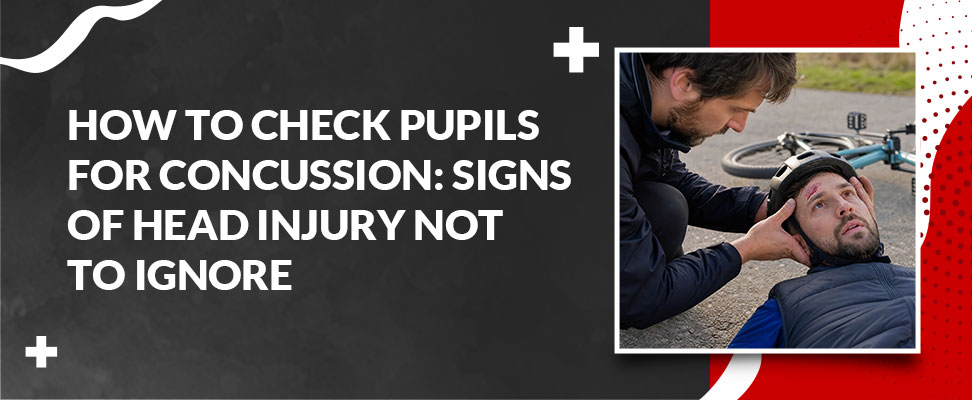
How to Check Pupils for Concussion: Signs of Head Injury Not to Ignore
A fall off a bike, a hard hit during a pickup game, a bump against a low cabinet door. When something like this happens to someone we care about, most of us do the same thing first. We look them in the eye and check their pupils, as if that one glance could tell us everything we need to know.
It can't, not on its own. Pupil checks matter, and we want to show you how to do them correctly, but a pupil check is one piece of a much larger picture. We'll walk through the safe way to check someone's pupils after a bump to the head, what a size difference actually means, and the complete list of danger signs the CDC says should send you straight to the emergency room, no matter what the pupils look like.
Key Takeaway
- Unequal pupils after a head injury can be a medical emergency. While some people naturally have different-sized pupils, a newly unequal pupil after a blow to the head is a CDC danger sign that requires calling 911 immediately. Knowing the difference between routine concussion symptoms and emergency warning signs can help you respond quickly and get the right medical care.
Why Pupils Matter After a Head Injury?
The muscles that open and close our pupils are controlled by a set of nerves that run close to the brain stem. Under normal conditions, both pupils shrink and widen together, matching each other in size and reacting the same way to light.
After a bump, blow, or jolt to the head, pressure or bleeding inside the skull can press on those nerves. When that happens, one pupil may stop responding normally while the other still works the way it should. That is why a new pupil size difference after a head injury is treated so seriously. According to CDC's HEADS UP program, one pupil larger than the other is listed among the specific danger signs that call for immediate emergency care, because it can point to a dangerous collection of blood building up inside the skull.
This is different from a typical concussion, which usually does not involve bleeding or swelling severe enough to affect the pupils. A pupil change points toward something more serious than a routine bump on the head, which is exactly why it gets treated as an emergency signal rather than a wait-and-monitor situation.
How to Check Someone's Pupils Safely
You don't need special training or equipment to check someone's pupils. Follow these simple steps:
-
Check the pupils in normal lighting. Avoid dark rooms, as low light naturally causes pupils to widen and can make them appear uneven. Look at both pupils to see if they are similar in size and shape.
-
Use a small light source. Shine a phone flashlight or penlight briefly into one eye, then the other.
-
Watch how each pupil responds. A normal pupil should constrict quickly when exposed to light and return to its usual size once the light is removed. Compare how both eyes react, not just their size at rest.
-
Keep the examination brief. A few seconds per eye is enough. There's no need to hold the light in place or repeat the test multiple times.
-
Know when to seek emergency care. If one pupil is noticeably larger than the other or one pupil responds much more slowly to light, seek emergency medical attention immediately, especially after a head injury.
Important: Checking someone's pupils does not replace a medical evaluation. If unequal pupils develop after a head injury or are accompanied by symptoms such as worsening headache, repeated vomiting, confusion, seizures, or loss of consciousness, call emergency services right away.
What Unequal Pupils Actually Means
Not all cases of unequal pupils are caused by a head injury. The key is whether the difference is new or has always been present.
|
Normal (Usually Not an Emergency) |
Concerning (Seek Medical Attention) |
|
Some people naturally have pupils that differ slightly in size, a condition called physiologic anisocoria. |
One pupil becomes larger than the other after a bump, blow, or jolt to the head. |
|
The size difference is usually small and remains consistent over time. |
The difference is new, especially if the person's pupils were previously equal. |
|
There are no new symptoms related to the pupil difference. |
The unequal pupils are accompanied by symptoms such as confusion, worsening headache, repeated vomiting, drowsiness, seizures, or loss of consciousness. |
If You're Not Sure, Treat It Seriously
Most people don't know what someone else's pupils normally look like. If you notice unequal pupils after a head injury and can't tell whether the difference is new, it's safest to treat it as a potential emergency and seek immediate medical evaluation.
The most important factor isn't simply whether the pupils are unequal; it's when the difference appeared and whether it developed after the head injury.
The Full List of CDC Concussion Danger Signs
Pupils are one entry on a much longer list. According to CDC's HEADS UP program, call 911 or go to the emergency department right away if someone shows any of these signs after a bump, blow, or jolt to the head.
-
One pupil larger than the other
-
Drowsiness or inability to be awakened
-
A headache that gets worse and does not go away
-
Weakness, numbness, or decreased coordination
-
Repeated vomiting or nausea
-
Slurred speech
-
Convulsions or seizures
-
Difficulty recognizing people or places
-
Increasing confusion, restlessness, or agitation
-
Unusual behavior
-
Loss of consciousness, even briefly
Any one of these on its own is enough to call 911. You do not need to see several signs together before acting, and you do not need to confirm a pupil difference before treating another sign, like slurred speech or repeated vomiting, as serious. Each item on this list exists because it can independently point to a dangerous buildup of blood or swelling inside the skull.
This list is not something to memorize under pressure. It is something to recognize quickly enough to act on, which is exactly the kind of pattern recognition that formal first aid training builds through repetition rather than a single read-through.
General Concussion Signs vs. Danger Signs
Not every symptom after a head injury requires calling 911, but some do. The table below explains the difference.
|
General Concussion Signs |
Danger Signs (Call 911 Immediately) |
|
Appears dazed or confused |
One pupil is larger than the other |
|
Answers questions slowly or repeats questions |
Loss of consciousness or inability to wake up |
|
Difficulty remembering events before or after the injury |
A headache that gets worse over time |
|
Moves clumsily or has balance problems |
Repeated vomiting |
|
Headache, dizziness, or nausea |
Seizures or convulsions |
|
Sensitivity to light or noise |
Increasing confusion, unusual behavior, or agitation |
|
Feels mentally "foggy" or has trouble concentrating |
Weakness, numbness, or difficulty speaking |
|
Changes in mood, sleep, or memory |
Any symptom that rapidly worsens after the injury |
What Should You Do?
-
General concussion signs should be evaluated by a healthcare provider as soon as possible, ideally the same day.
-
Danger signs may indicate serious bleeding or swelling inside the skull and require immediate emergency medical care.
-
If you're unsure whether a symptom is a danger sign, err on the side of caution and seek emergency medical attention.
What to Do While Waiting for Help
Once you have called 911 or decided to head to the emergency department, a few simple actions help keep the person safe until professional help takes over.
Keep them still and avoid moving their head or neck any more than necessary. A hit hard enough to cause a head injury can also affect the spine, so unnecessary movement is a real risk, not just a precaution. If repositioning becomes necessary and you are trained, our guide to the recovery position in CPR walks through when it is appropriate and how to do it without compromising the airway or the spine.
Keep watching for any of the danger signs above, including ones that were not present a few minutes ago. Symptoms can appear or worsen quickly after a head injury, so this is not a one-time check. Do not leave the person alone, even if they insist they feel fine. A head and neck injury can also change how you respond if the person stops breathing, which is part of why it helps to know when CPR should not be started and how a suspected spinal injury factors into that decision.
Know the Signs, Then Get the Training to Back It Up
Recognizing a pupil change or another danger sign is only half the job. Knowing exactly what to do in the seconds after, how to keep someone still, how to talk to a 911 dispatcher, when to start CPR and when to hold off, is what formal training builds. Our First Aid certification course covers head injury response alongside the full range of everyday emergencies, and it is built to be finished in about an hour, from home, for $19.95.
If you are also responsible for kids, our Adult CPR + First Aid course covers pediatric response too, so you are ready no matter who needs help.


QUICK Q&A
What does it mean if someone has unequal pupils after a head injury?
A new difference in pupil size after a head injury is a CDC danger sign that requires immediate emergency medical care. It may indicate bleeding or increased pressure inside the skull.
How do you check someone's pupils after a head injury?
Check the pupils in normal lighting, then briefly shine a small light into each eye. Both pupils should constrict quickly and respond similarly. If one pupil is noticeably larger or reacts differently, seek emergency medical care.
Can someone naturally have unequal pupils?
Yes. Some people have a harmless, lifelong difference in pupil size called physiologic anisocoria. The concern is when the difference appears for the first time after a head injury.
What are the CDC's danger signs after a head injury?
CDC danger signs include one pupil larger than the other, worsening headache, repeated vomiting, seizures, slurred speech, increasing confusion, weakness or numbness, difficulty waking up, and loss of consciousness. Any of these signs requires immediate emergency care.
Do normal-looking pupils rule out a concussion?
No. Many people with a concussion have normal pupils. Pupil size is only one part of the assessment, so watch for other concussion symptoms and danger signs as well.
When should you call 911 after a head injury?
Call 911 immediately if the person develops unequal pupils, loses consciousness, has repeated vomiting, seizures, slurred speech, increasing confusion, a worsening headache, or any other CDC danger sign after the injury.
Related Posts

CPR Guidelines – What You Need to Know
Cardiopulmonary resuscitation, commonly known as CPR, is a medical response to cardiac arrest that began in the early 1900s. Starting as an attempt to rescue drowning victims, CPR was not fully developed in its modern form until 1960. Since that time, medical boards have worked to further understand and improve upon CPR as a life […]
Fast Family Saves Dad with CPR
It’s not uncommon for folks in their fifties to have sudden cardiac arrest, and that’s exactly what happened to John recently while he was playing basketball with friends and family. They immediately began CPR. A move that saved his life. John is recovering, thanks to his fast-thinking family. Anyone who has served a heart attack […]
Lightening Strike Kills Boy; CPR Brings Him Back to Life
He was technically dead.His heart had stopped beating.His clothes were burning. And two bystanders started CPR on the 12-year-old boy, saving his life. Today, Ken Nilson is a firefighter in Bremerton, Washington. “It was an experience that would profoundly change my life forever,” explains Nilson. He makes it a point to teach young children ways […]
CPR Training for EveryOne
Style Snapshot CPR training is a crucial life-saving skill that everyone should learn. Whether for cardiac arrest, drowning, or choking emergencies, CPR can double or triple a victim’s chance of survival. With modern guidelines now emphasizing hands-only CPR, more people can confidently act without fear of doing it wrong or being sued under Good Samaritan […]

CPR Metronome Pen
It’s true that performing CPR to The Bee Gee’s Stayin’ Alive is the perfect cadence, but what if you don’t know the song, or have no rhythm? If so, take a look at these CPR apps worth downloading today. Style Snapshot The CPR Metronome Pen from LyfeTymer is a practical tool designed to help deliver […]
First Aid Safety – How to Keep a Safe Home
It is a common to want to upgrade your home. Perhaps when you look around you might decide that it is time for a new rug, a bigger television, or fresh paint. But have you ever considered if the first aid and safety level of your home needs an upgrade? No matter your lifestyle, whether […]