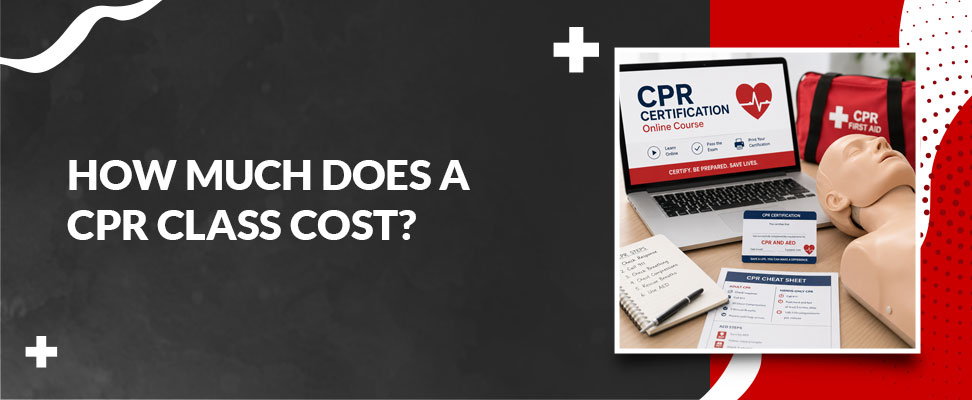
CPR certification costs anywhere from free to over $300, and the range is not random. Format, certification level, and provider each significantly affect the number. Online CPR courses typically run $14 to $55. In-person and blended courses cost between $50 and $100. Healthcare provider BLS certifications average $60 to $120. Advanced ACLS and PALS courses can reach $150 to $300 or more.
Key Takeaway
- If you need standard CPR and AED certification for workplace compliance, a childcare license, or personal preparedness, SimpleCPR offers full online certification starting at $19.95, completed in under 60 minutes with a printable certification card issued the moment you pass. No commute, no scheduling, no waiting.
CPR Class Pricing in the United States
The cost of a CPR class depends primarily on three variables: how you take the course, the type of certification you need, and which provider you choose. Once you understand those levers, the price makes sense quickly.
At the affordable end, fully online CPR certification from SimpleCPR starts at $19.95 and includes the course, the exam, and a printable certification card with no add-on fees. At the higher end, Advanced Cardiac Life Support (ACLS) and Pediatric Advanced Life Support (PALS) courses for critical care professionals can exceed $300 at some training centers.
For most people seeking CPR and AED certification for a job requirement, childcare license, or general preparedness, the realistic range is $19 to $55 online or $50 to $100 for an in-person class with hands-on skills practice.
CPR Certification Cost by Course Type
|
Course Type |
Online Cost |
In-Person / Blended Cost |
Who It Is For |
|
Standard CPR / AED (Adult) |
$14 to $55 |
$50 to $80 |
General public, workplace compliance, personal preparedness |
|
CPR / AED (Adult, Child, Infant) |
$19 to $55 |
$50 to $80 |
Parents, caregivers, teachers, coaches, babysitters |
|
CPR + First Aid Combo |
$34 to $60 |
$60 to $100 |
Childcare workers, sports staff, fitness instructors |
|
Pediatric / Infant CPR |
$19 to $40 |
$40 to $70 |
Parents, babysitters, licensed childcare providers |
|
BLS for Healthcare Providers |
$19 to $60 |
$60 to $120 |
Nurses, physicians, dental staff, EMTs, paramedics |
|
Group CPR Training (per person) |
$15 to $35 |
$35 to $55 |
Employers, organizations, schools, nonprofits |
|
ACLS / PALS (Advanced) |
Not typically available |
$150 to $300+ |
ICU, ER, and critical care professionals |
SimpleCPR covers all categories above starting at $19.95, including Adult CPR/AED, Adult-Child-Infant CPR/AED, BLS for Healthcare Providers, and CPR + First Aid combos.
Online vs. In-Person vs. Blended CPR: The Real Cost Comparison
One of the most common sources of confusion when budgeting for CPR certification is the difference between online-only, in-person, and blended learning formats. Each carries a different total cost when you factor in travel time, materials, scheduling delays, and the credential you actually walk away with.
|
Factor |
Online Only |
In-Person |
Blended |
|
Typical Course Fee |
$14 to $55 |
$50 to $100 |
$50 to $90 |
|
Travel or Commute Cost |
$0 |
$5 to $30 |
$5 to $20 |
|
Time Required |
45 to 90 min |
3 to 6 hours |
2 to 4 hours total |
|
Instant Certification Card |
Yes, print immediately |
Issued same day |
After the skills session |
|
Accepted for Workplace Compliance |
Yes |
Yes |
Yes |
|
Meets Clinical Healthcare Credential |
Varies by employer |
Yes |
Yes |
|
Best For |
Most individuals and employers seeking affordable, fast certification |
First-time learners who prefer hands-on instruction |
Healthcare professionals needing documented skills verification |
For most people, the most affordable and fastest path to CPR certification is a fully online course. A standard adult CPR and AED certification from SimpleCPR costs $19.95, takes under one hour to complete, and produces a printable certification card the moment you pass. No scheduling, no travel, no waiting for a card in the mail.
Important note: If you are a practicing nurse, physician, paramedic, or other clinical healthcare professional whose licensing board requires a documented in-person skills assessment, a blended or fully in-person course may be required. Confirm the specific requirements with your employer or licensing board before enrolling. Check out our BLS certification page to see what options may apply to your role.
What Factors Drive CPR Class Costs
Several variables determine whether a CPR course costs $19 or $300. Understanding them helps you choose what you actually need without overpaying for credentials you do not require.
Course Format
Online courses cost less because there is no instructor time, facility rental, or mannequin use built into the price. In-person courses pass those overhead costs on to students. Blended courses sit in between, combining online coursework with a shorter in-person skills session.
Certification Type
Standard CPR and AED certification for the general public costs far less than Basic Life Support (BLS) for healthcare providers or advanced courses like ACLS and PALS. The more specialized the credential, the higher the cost.
Provider
Large national training organizations charge more because their instructor networks, training centers, and physical course materials all add overhead. Online providers offering nationally accepted certification can eliminate most of that physical infrastructure, passing the savings on to you.
Certification Card vs. Completion Card
Some low-cost or free online options issue a completion card rather than a formal certification. These may not be accepted for professional licensing or workplace compliance. Before you enroll, confirm whether the course delivers the specific credential your employer or licensing body requires. SimpleCPR issues full certification cards, not completion cards.
Materials and Add-Ons
Some providers charge separately for study guides, wallet cards, digital certificate downloads, or proctored exam access. Watch for these additions when comparing prices. SimpleCPR’s prices (from $19.95) include the course, the exam, and the printable certification card with no surprise fees added at checkout.
Location
In-person classes in major metro areas typically cost more than those in smaller markets because of higher instructor rates and facility costs. Online courses eliminate location as a pricing variable entirely.
What Is Actually Included in the CPR Class Fee
What you get for the advertised price varies considerably between providers, and this is one of the most overlooked cost factors when comparing CPR certification options.
At SimpleCPR, the course fee ($19.95 for CPR/AED, BLS, or Bloodborne Pathogens; $34.95 for CPR + First Aid) includes the full online training course, the certification exam, and a printable certification card issued immediately upon passing. There is no additional charge to access your certificate, and no expiration on test retakes during the session. You can learn more about our online CPR courses here.
With some providers, watch for these fees that may be charged on top of the advertised course price:
- Exam access fees are charged separately from the course
- Certification card fees added at checkout (typically $5 to $15)
- Physical wallet card mailing fees
- Downloadable PDF certificate fees
- Retake fees if you do not pass the exam on the first attempt
- Study material charges for reference guides or printed resources
Before purchasing any CPR course, confirm whether the advertised price includes the certification card, the exam, and enough retake attempts to pass. At SimpleCPR, exam retakes are unlimited at no extra charge.
Does Your Employer Have to Pay for Your CPR Training
This is one of the most frequently asked cost questions about CPR certification, and one that most price guides fail to answer clearly. The short answer is that it depends on your state, your industry, and whether the training is legally required for your specific role.
Under the federal Fair Labor Standards Act (FLSA), employers are not universally required to pay for CPR certification costs. However, if CPR training is a mandatory condition of employment, your employer must compensate you for the time spent completing that training, even if they do not cover the course fee directly.
Some states go further. California’s Labor Code and Code of Regulations specify that any training mandated by an employer must be fully paid for by the employer, including course fees.
OSHA regulations also establish clearer obligations in certain industries. Under 29 CFR 1910.151 (General Industry), employers in workplaces without on-site medical facilities must ensure trained first aid personnel are available. In those situations, many employers in healthcare, construction, and licensed childcare cover CPR certification costs as part of standard employee onboarding. Note that OSHA recommends CPR as part of a first aid program, and specific OSHA standards, including logging operations (29 CFR 1910.266) and permit-required confined spaces (29 CFR 1910.146) require CPR training directly.
Jobs where employers commonly cover CPR certification costs include:
- Nurses, physicians, dental staff, and other licensed healthcare professionals
- Emergency medical technicians and paramedics
- Firefighters and law enforcement officers
- Lifeguards and swim instructors
- Licensed childcare workers and daycare staff
- Construction site workers in OSHA-regulated environments
If you are paying for CPR certification out of pocket because your employer requires it, review your state labor laws. You may be entitled to reimbursement. Ask your HR department whether your organization has a policy for covering required training costs before you pay.
Can You Use FSA or HSA Funds for a CPR Class
No. CPR class costs are not eligible for reimbursement with a Flexible Spending Account (FSA), Health Savings Account (HSA), Health Reimbursement Arrangement (HRA), Limited-Purpose FSA, or Dependent Care FSA.
Under IRS Code Section 213(d) and IRS Publication 502, a medical expense must relate to the diagnosis, cure, mitigation, treatment, or prevention of a disease for the account holder or their dependent. Because CPR training is a general safety skill and not a treatment for a personal medical condition, it does not meet this standard. Using FSA or HSA funds for CPR classes incorrectly could trigger a 20% tax penalty plus income tax on the amount withdrawn or reimbursed.
One limited exception: CPR classes taken as part of a birthing or prenatal class may be eligible for FSA reimbursement under some plan structures. Confirm this with your specific plan administrator before proceeding.
The most effective ways to reduce the out-of-pocket cost of CPR certification are to choose an affordable online provider, ask your employer about coverage, take advantage of group rates if multiple people need certification, or attend a free community training event if formal certification is not required.
How to Get CPR Certified for Less
Choose Online Certification
Online CPR courses like those at SimpleCPR start at $19.95 and can be completed in under one hour at any time of day. That is typically 50 to 70 percent less than the cost of an equivalent in-person class, with the same nationally accepted credential issued upon completion. Our courses are based on AHA (American Health Association) and OSHA guidelines, and over 99% of our students report that their employer accepted their certification. Every employer sets its own rules, so confirm yours before you buy.
Use Group Rates
If multiple people at your workplace or organization need CPR certification, group pricing can significantly reduce the per-person cost. SimpleCPR offers group accounts for employers and organizations certifying five or more people at once, with group discounts available.
Check With Your Employer First
Before paying out of pocket, ask your HR department whether your organization covers CPR certification costs for your role. Many employers in healthcare, construction, and childcare budget for this as part of standard workforce training.
Watch for Community Programs
Local hospitals, fire stations, community colleges, and health departments occasionally offer free or reduced-price CPR training events. These are worth checking for awareness training, though they typically do not issue nationally accepted certification cards.
Do Not Pay for More Than You Need
You do not need lifetime certification, advanced course bundles, or BLS credentials unless your employer or licensing body specifically requires them. For most workplace requirements and personal preparedness, a standard online CPR and AED certification is sufficient and the most cost-effective option available.