




AED Pads for Adults: Types, Placement, and When to Replace Them
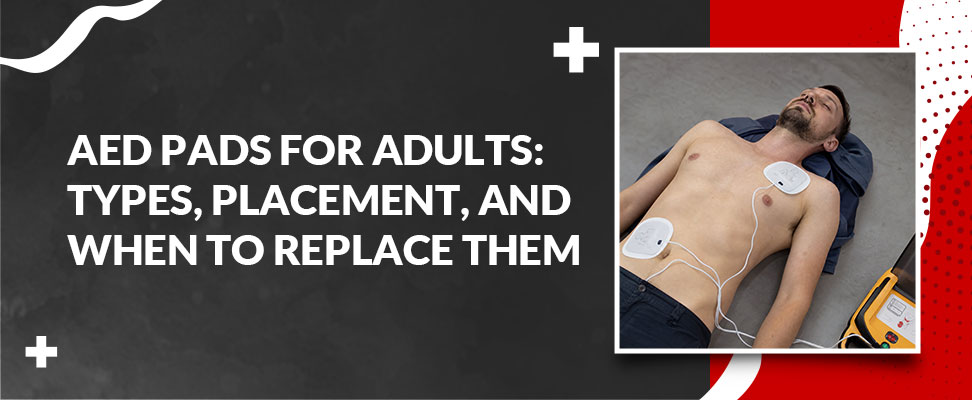
Adult AED pads are adhesive electrode pads placed on the bare chest of a person experiencing sudden cardiac arrest. They connect the patient to the AED, allowing it to analyze the heart rhythm and deliver a life-saving electrical shock. For adults and anyone over 8 years old or weighing more than 55 pounds, specific adult-size pads and placement positions are always required.
Key Takeaway
- Adult AED pads are essential for delivering a life-saving shock during sudden cardiac arrest, and correct placement helps ensure effective defibrillation. Always follow the AED’s instructions and use pads compatible with the specific device. Check expiration dates regularly and replace pads after every emergency use or if the packaging is damaged. Understanding adult and pediatric pad differences, along with special placement considerations, helps you respond more confidently in an emergency. Regular AED inspections and hands-on CPR/AED training help keep you prepared when every second counts.
What Are Adult AED Pads?
AED electrode pads, sometimes called defibrillator pads or electrodes, are the critical interface between an automated external defibrillator and the patient's heart. Each pad is coated with a conductive adhesive gel that allows the device to both read the heart's electrical activity and deliver a controlled shock when a shockable rhythm, such as ventricular fibrillation, is detected.
Adult AED pads are designed to deliver a higher-energy shock appropriate for a fully developed cardiovascular system. The American Heart Association (AHA) guidelines specify that adult pads should be used on any person aged 8 years or older or weighing more than 55 pounds (25 kilograms), regardless of age. Every AED sold in the United States must be FDA-approved, which means the pad adhesive, energy delivery parameters, and labeling all meet established safety standards.
Because AED pads are single-use consumables, they must be replaced after every emergency deployment (even if no shock was delivered) and before their printed expiration date. This is a detail that surprises many new AED owners: the pads expire on schedule regardless of whether the device has ever been used.
Types of Adult AED Pads:The Guide No E-Commerce Page Gives You
Most guides skip this section entirely. Understanding the different types of adult AED pads before an emergency occurs is one of the most underrated elements of AED preparedness. It is exactly the kind of knowledge that differentiates a trained responder from an untrained bystander.
Standard Electrode Pads
Standard electrode pads are the most widely used type. They consist of two separate adhesive pads connected to the AED unit via cables. You manually peel each pad from its backing and press it firmly onto the appropriate position on the patient's bare chest. Standard pads are the default configuration for most AED brands, including ZOLL STAT-PADZ, Defibtech Lifeline pads, and Cardiac Science PowerHeart pads. These pads are available for both adults and children and are the most straightforward to stock and replace.
Pre-Connected Pads
Pre-connected pads come already attached to the AED unit with cables, eliminating the step of connecting the pad cable during an emergency. Philips HeartStart models, including the FRx, use a pre-connected pad cartridge system. When the device is opened and turned on, the pads are immediately ready to apply, removing one step from an already high-stress situation. This design is particularly valuable in public-access settings where untrained bystanders may need to act quickly.
Universal / Uni-Pads
Universal pads, sometimes called uni-pads, are designed to work on both adults and children by automatically adjusting the energy level delivered based on pad-detected signals or a manual switch. ZOLL AED 3 and certain Philips FRx models support universal pad configurations. Uni-pads eliminate the need to carry two separate pad sets and reduce the risk of grabbing the wrong pads in an emergency. For organizations that serve both adults and children (schools, community centers, fitness facilities) this is an important capability to know before purchasing.
Training Pads
Training pads are semi-adhesive, reusable pads designed exclusively for use with AED trainer units in practice scenarios. They simulate the feel and application of real pads without consuming rescue supplies. SimpleCPR's Adult CPR/AED course [LINK → https://www.simplecpr.com/adult-cpr-aed] teaches proper pad application and placement as part of AED certification. One reason hands-on practice with training pads builds the muscle memory that matters in a real emergency. Training pads should never be used with a live AED on a patient.
CPR Feedback Pads
Some advanced AED pad models include built-in CPR feedback sensors. AED.com notes that certain electrode pads are designed to provide real-time CPR guidance, monitoring compression depth and rate while defibrillation is being prepared or performed. ZOLL's CPR-D-Padz are the most widely recognized example of this design. For healthcare providers and high-performance CPR programs, feedback-enabled pads provide continuous quality monitoring alongside defibrillation capability.
How to Place AED Pads on an Adult
Correct pad placement helps ensure the electrical current travels through the heart muscle via the most direct pathway, maximizing the chance of restoring a normal rhythm. Every AED sold with adult electrode pads includes placement diagrams printed directly on the pads: follow those diagrams as your first reference. The following applies to any adult victim aged 8 or older.
IMPORTANT: Do not delay defibrillation to resolve placement uncertainty. Survival rates drop 7–10% for every minute without a shock. If the pads are approximately in position, proceed. The AED's own prompts will guide you.
Anterolateral Placement: The Standard Adult Position
Anterolateral placement is the default method recommended by the AHA for all adult victims. "Anterior" means front; "lateral" means side. Follow these steps:
-
Step 1: Expose the chest. Remove or cut away clothing. AED pads will not function through fabric.
-
Step 2: Dry the chest. If the person is wet, quickly wipe the chest with a cloth or towel. Moisture reduces pad adhesion and can interfere with shock delivery.
-
Step 3: Check for obstructions. Look for excessive chest hair (shave quickly with the razor included in most AED kits), medication patches (remove them), or an implanted pacemaker/ICD (visible as a small bump under the skin: see special situations below).
-
Step 4: Place pad 1 (right chest). Position the first pad on the upper right side of the chest, just below the right collarbone (clavicle), to the right of the sternum (breastbone).
-
Step 5: Place pad 2 (left side). Position the second pad on the lower left side of the chest, below the armpit along the mid-axillary line, just below the left nipple.
-
Step 6: Connect and follow prompts. Plug in the cable connector if not pre-connected. Turn on the AED and follow its voice and visual prompts.
-
Step 7: Clear and analyze. Ensure no one is touching the patient while the AED analyzes the heart rhythm. If a shock is advised, ensure all bystanders are clear before pressing the shock button.
Anterior-Posterior Placement
Anterior-posterior (AP) placement positions one pad on the front of the chest and the other on the back. This method is most commonly used in clinical settings. It is also recommended when placing pads near an implanted pacemaker or ICD, or in certain obesity scenarios where AP placement provides better pad contact.
For AP placement on adults: position the anterior pad on the center of the left chest, over the cardiac apex. Position the posterior pad at the center of the back, between the shoulder blades, directly behind the anterior pad. Ensure both pads lie flat against bare skin and do not overlap or touch.
PLACEMENT COMPARISON TABLE:
|
Feature |
Anterolateral |
Anterior-Posterior |
When to Use |
|
Pad positions |
Right chest + lower left side |
Front chest + center back |
— |
|
AHA default? |
✓ Yes, standard for adults |
No, alternative method |
— |
|
Best for adults? |
Yes, all adult victims |
Yes, specific situations |
See notes below |
|
Use when the pacemaker is near the right shoulder? |
Move the pad at least 1 inch away from the device |
✓ Preferred alternative |
Pacemaker / ICD present |
|
Clinical use? |
Yes |
✓ Often preferred in clinical settings |
Manual defibrillators, hospital |
|
Pad overlap risk? |
Low, pads are on different sides. |
Low if positioned correctly |
— |
Special Situations for Adult AED Pad Placement
Standard anterolateral placement applies to the vast majority of adult victims. However, a handful of common situations require adjustments. Knowing these before an emergency removes hesitation.
Pacemaker or ICD
A pacemaker or implantable cardioverter-defibrillator (ICD) is visible as a small lump under the skin, typically in the upper chest area. Do not place an AED pad directly over the device as the metal housing can divert the shock away from the heart. Position the pad at least 1 inch (2.5 cm) away from the device. If the pacemaker is located where the right pad would normally go, use anterior-posterior placement instead.
Medication patches
Transdermal patches (nitroglycerin, nicotine, hormones) must be removed before applying pads. Leaving a patch under an electrode can cause skin burns and may interfere with current delivery. Wear gloves when removing a patch to avoid absorbing the medication yourself.
Wet chest
Moisture creates resistance and reduces pad adhesion. Quickly dry the chest with whatever is available (a shirt, towel, or jacket) before applying pads. Do not delay this step by more than a few seconds.
Excessive chest hair
Dense chest hair prevents pads from adhering to the skin. Most AED response kits include a disposable razor. Shave the specific area where each pad will be placed. If a razor is unavailable, press the pads down firmly and then peel them off quickly (the adhesive will pull some hair away), and then apply the second pair of replacement pads. This is why keeping a spare set of pads is always recommended.
Pregnant women
AED pad placement for pregnant women is identical to standard adult anterolateral placement. The AHA confirms that defibrillation does not harm the fetus and must not be delayed. Restoring the mother's heart rhythm is the highest priority for both lives.
Large breasts
The lateral pad should be positioned beneath the breast tissue, not on top of it. Direct skin contact is required for effective defibrillation.
Adult vs. Pediatric AED Pads: Key Differences
One of the most important questions in AED readiness is knowing when to use adult pads and when to use pediatric pads, and what to do when you have only one type available.
|
Factor |
Adult AED Pads |
Pediatric AED Pads |
|
Designed for |
Adults and children ≥ 8 years or ≥ 55 lbs |
Children < 8 years or < 55 lbs (25 kg) |
|
Energy level |
Higher joule output, appropriate for the adult heart |
Attenuated / reduced joule output (safe for pediatric heart) |
|
Pad size |
Larger |
Smaller, designed for a smaller chest wall |
|
Default placement |
Anterolateral (right chest + lower left side) |
Anterior-posterior (front chest + back) |
|
If only adult pads are available for a child? |
Use adult pads (a shock with adult pads is better than no shock). Position front-to-back to prevent overlap. |
N/A |
|
Can pediatric pads be used on adults? |
No. AHA guidelines advise against it. The pediatric energy dose is too low for an adult heart. Do not substitute. |
N/A |
The critical takeaway: if no pediatric pads are available, use adult pads on a child rather than doing nothing. But never reverse this and use child pads on an adult victim. The energy delivered will almost certainly be insufficient to convert the arrhythmia.
AED Pad Expiration and Replacement: A Schedule That Saves Lives
AED pads expire because the conductive adhesive gel they rely on degrades over time. Once the gel dries out or loses adhesion, the pads may not stick properly to the patient's chest, creating resistance that reduces or blocks the shock's effectiveness. An AED with expired pads may still power on and appear functional, but it cannot be relied upon in a rescue.
Expired pads are one of the leading causes of AED failure when a device is actually needed. Routine maintenance prevents this entirely.
|
AED Brand / Model |
Adult Pad Shelf Life |
Battery Life |
Notes |
|
Philips HeartStart OnSite / HS1 |
~2 years |
~4 years |
SMART Pads Cartridge (M5071A) with expiry printed on package |
|
ZOLL AED Plus |
CPR-D-Padz: ~5 years; STAT-PADZ II: ~2 years |
~5 years |
Two pad options available, so confirm which your unit uses |
|
HeartSine Samaritan PAD |
~4 years (Pad-Pak combined) |
~4 years (Pad-Pak combined) |
Battery and pads in one cartridge, so one expiration to track |
|
Defibtech Lifeline |
~2 years |
5–7 years (model dependent) |
Always replace pads immediately after any emergency use |
|
Cardiac Science Powerheart |
~2 years |
Per model spec |
Check packaging (date printed on cartridge label) |
REPLACE PADS IMMEDIATELY if any of the following apply:
-
The printed expiration date on the package has passed.
-
The pads were applied to a patient during an emergency (even if no shock was delivered).
-
The pad package has been opened, torn, punctured, or shows signs of moisture damage.
-
The AED's status indicator is showing a warning or fault rather than a ready signal.
Best practice for organizations: conduct a monthly visual inspection of each AED. Confirm the status indicator is green, check the expiration date on the pad package, and order replacements at least 60 days before expiration to avoid gaps in coverage.
AED Pads and CPR Certification: What Every Trainee Needs to Know
Understanding AED pads on paper is valuable. Applying them under pressure (when someone has collapsed, bystanders are panicking, and every second counts) is a different skill entirely. This is why hands-on AED training matters.
In SimpleCPR's Adult CPR/AED certification course, students learn AED pad application as an integrated component of the full chain-of-survival response: recognizing cardiac arrest, calling 911, starting CPR compressions, and deploying the AED without interrupting chest compressions for longer than necessary. The AED prompts guide the rescuer through analysis and shock delivery, but trainees who have practiced the physical steps of pad application are measurably faster and more confident.
Key skills the certification covers related to AED pads:
-
Identifying which pads to use (adult vs. pediatric) for the victim in front of you.
-
Applying pads to bare skin while another responder maintains chest compressions.
-
Recognizing and responding to common complications: wet chest, hairy chest, visible pacemaker.
-
Coordinating the "all clear" call before shock delivery to protect bystanders.
-
Resuming CPR immediately after shock delivery without waiting for the AED's next analysis cycle to complete.
National data consistently show that bystander AED use before emergency services arrive significantly increases cardiac arrest survival rates. CPR and AED certification empowers anyone (regardless of medical background) to act with confidence in those first critical minutes. SimpleCPR's courses are completed in 60 minutes or less, are based on the latest AHA guidelines, and can be accessed 24 hours a day.



QUICK Q&A
Where exactly do you place AED pads on an adult?
For adults, use anterolateral placement: place one pad on the upper right chest, just below the right collarbone to the right of the sternum; place the second pad on the lower left side of the chest, below the left nipple along the mid-axillary line (side of the chest). Both pads must be pressed firmly against bare skin. The AED pads themselves have printed diagrams showing correct placement.
What types of adult AED pads are available?
Adult AED pads come in five main types: standard cable-connected electrode pads (the most common), pre-connected pads that come already attached to the AED cable (such as Philips HeartStart FRx pads), universal/uni-pads that work for both adults and children with adjusted energy, CPR feedback pads that monitor compression quality, and training pads that are semi-adhesive and reusable for practice sessions only. Each AED model is compatible with specific pad types.
Can you use pediatric AED pads on an adult?
No. The American Heart Association guidelines explicitly advise against using pediatric pads on an adult. Pediatric pads deliver a reduced energy dose designed for a small child's heart- that dose is almost certainly insufficient to correct an adult's shockable rhythm. If only child pads are available, perform high-quality CPR rather than attempting to shock with undersized pads.
How often do adult AED pads need to be replaced?
Adult AED pad shelf life varies by manufacturer: typically 2 years for Philips SMART Pads, approximately 5 years for ZOLL CPR-D-Padz, and 4 years for HeartSine Pad-Pak cartridges. Replace pads by the printed expiration date on the packaging or immediately after any emergency deployment, even if no shock was given. Never wait until the expiration day- order replacements 60 days early.
Do AED pads expire if they have never been used?
Yes. AED pads expire based on time, not usage. The conductive adhesive gel on the pads gradually dries out, whether or not the pads have ever been applied to a patient. An AED with expired pads may still power on and appear ready, but the pads cannot reliably adhere to the patient's skin or conduct electricity. Always check the printed expiration date, not the device's power indicator, when assessing pad readiness.
Can an AED be used on someone with a pacemaker?
Yes- do not withhold defibrillation from a victim just because they have a pacemaker or ICD. Follow normal cardiac arrest response. Simply avoid placing the electrode pad directly over the implanted device (which is visible as a small lump under the skin). Position the pad at least 1 inch away from the device, or switch to anterior-posterior pad placement to keep both pads away from the implant location.
Can adult AED pads be used on a pregnant woman?
Yes. AED pad placement for a pregnant woman is identical to standard adult anterolateral placement. The AHA confirms that defibrillation is safe during pregnancy and should not be delayed. The electrical current targets the heart and does not travel to the uterus in sufficient quantity to harm the fetus. Restoring the mother's cardiac rhythm is the immediate priority for both mother and baby.
Are adult AED pads interchangeable between different AED brands?
No. AED pads are model-specific. Each manufacturer uses proprietary connectors and pad configurations, and pads from one brand will not reliably interface with those of another brand. Always purchase replacement pads from the same manufacturer as your AED unit and confirm the exact model compatibility before ordering. If you manage AEDs from multiple manufacturers, track pad replacement schedules separately for each unit.
Related Posts
AEDs and LUCAS Devices: What They Are & How They Work
LUCAS Devices: What They Are & How They Work AEDs and LUCAS devices are two of the most commonly used pieces of medical equipment in emergency situations. Many people are familiar with automated external defibrillators (AEDs), but not everyone is familiar with the LUCAS device. AEDs, or automated external defibrillators, are portable devices that deliver […]

Online CPR and First Aid Certification – What’s Involved
If you need to take a CPR or first aid class in order to become certified either for your job or for your own personal preparedness, you might want to consider an online CPR first aid certification. Online training, whether it is for first aid, CPR, BLS, or bloodborne pathogens, is a convenient way to […]

PPE for Bloodborne Pathogens: The Complete OSHA-Compliant Guide
Key Takeaway PPE for bloodborne pathogens helps protect workers from exposure to infectious blood and potentially infectious body fluids. Choosing the right equipment, including gloves, gowns, masks, and eye protection, depends on the task and anticipated exposure risk. Proper donning, doffing, and disposal procedures help prevent accidental contamination and reduce the risk of infection. OSHA […]
New Law Requires CPR Training in Illinois High Schools
Style Snapshot A new Illinois law requires high school students to receive CPR and defibrillator (AED) training before graduation. Inspired by families who lost children to on-campus cardiac emergencies, this legislation sets a precedent for other states. While students can opt out, the goal is to ensure every student understands how to respond in an […]

A Guide to How One Can Achieve a High Chest Compression Fraction
Chest compression fraction (CCF) is a critical measure of CPR quality. It refers to the percentage of time during a cardiac arrest in which chest compressions are actively being delivered. A high CCF improves blood flow to vital organs, especially the heart and brain, which add to the chances of survival and better outcomes for […]

Brothers Change CPR History
Each day more than one-thousand people receive CPR from bystanders, and less than ten-percent survive. But two brothers set out to change those numbers. John and Christopher Di Capua wanted to improve the number of lives saved with CPR. So, they did what any inventive and forward-thinking high student would do—they built a machine that […]