




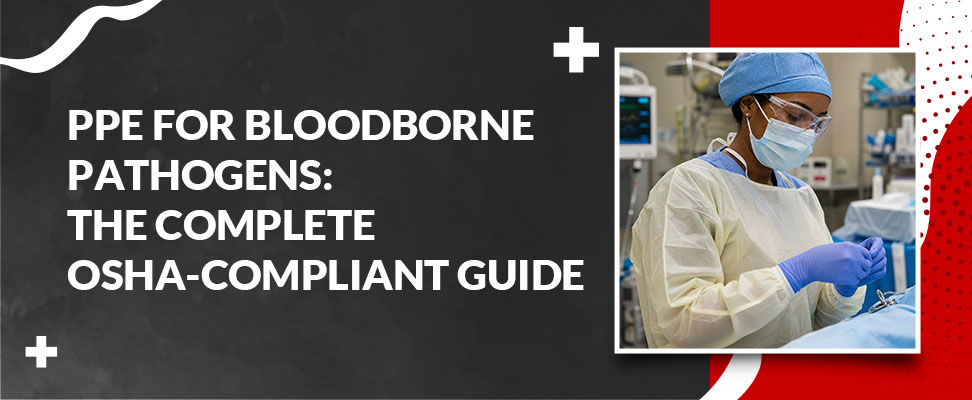
PPE for Bloodborne Pathogens: The Complete OSHA-Compliant Guide
Key Takeaway
- PPE for bloodborne pathogens helps protect workers from exposure to infectious blood and potentially infectious body fluids. Choosing the right equipment, including gloves, gowns, masks, and eye protection, depends on the task and anticipated exposure risk. Proper donning, doffing, and disposal procedures help prevent accidental contamination and reduce the risk of infection. OSHA requires employers to provide appropriate PPE and annual training for workers with occupational exposure. Regular training and consistent use of Standard Precautions help maintain a safer workplace.
What Is PPE for Bloodborne Pathogens?
Personal protective equipment (PPE) for bloodborne pathogens refers to specialized garments and devices that create a physical barrier between a worker's skin, eyes, and mucous membranes and potentially infectious blood or body fluids. OSHA defines bloodborne pathogens as pathogenic microorganisms present in the human blood that cause disease in humans, most notably hepatitis B virus (HBV), hepatitis C virus (HCV), and human immunodeficiency virus (HIV).
According to the CDC, approximately 5.6 million U.S. workers face occupational exposure to bloodborne pathogens each year. This is a number that extends well beyond hospitals and clinics. Any occupation where contact with blood or OPIM is reasonably anticipated falls under OSHA's Bloodborne Pathogens Standard, 29 CFR 1910.1030.
PPE does not eliminate the hazard at its source (engineering controls and work practice controls serve that function), but it provides the final, critical protective layer when those other controls cannot fully eliminate exposure risk. OSHA requires all three layers working together: engineer out the hazard where possible, modify work practices to reduce risk, and use PPE as the last line of defense.
Types of PPE Required for Bloodborne Pathogens
Gloves
Gloves are the baseline requirement for virtually every BBP exposure scenario. They are required whenever there is potential for hand contact with blood, OPIM, contaminated surfaces, or mucous membranes. Acceptable glove materials include nitrile, latex, vinyl, and other impervious compounds. Latex gloves should be powder-free and reduced-protein to minimize allergy risk; nitrile is now the preferred standard in most clinical and first-responder settings.
Gloves must be inspected before each use for tears or punctures, replaced immediately if damaged, and removed carefully using the glove-to-glove / skin-to-skin technique to avoid contaminating bare hands. Wearing two pairs (double-gloving) provides additional protection in high-risk procedures but is not a substitute for undamaged gloves.
Face Shields and Eye Goggles
Eye protection is required whenever tasks create a risk of splashes, sprays, spatters, or droplets of blood or OPIM reaching the eyes, nose, or mouth. Chemical splash goggles protect the eyes from direct exposure, while face shields provide broader coverage of the nose, mouth, and chin. In high-splash environments (surgeries, autopsies, trauma response), both may be worn simultaneously.
Gowns, Lab Coats, and Protective Clothing
Body-covering PPE is required whenever blood or OPIM may come into contact with the worker's clothing or skin. Options include gowns, aprons, lab coats, or clinic jackets. The garment must not allow blood or OPIM to penetrate to the worker's clothing underneath. When gross contamination is anticipated (major trauma response, autopsy, large-scale spill cleanup), surgical caps, shoe covers, and full-body protective coveralls may also be required.
Masks
Surgical masks or respirators protect the nose and mouth from splashes or sprays. They are always worn in combination with eye protection, not as a standalone. The mask-plus-goggles or mask-plus-face-shield combination covers all facial mucous membranes and is the standard configuration for high-splash clinical tasks.
Pocket Masks and Resuscitation Devices
Pocket masks and bag-valve-mask (BVM) devices eliminate direct mouth-to-mouth contact during CPR and other resuscitation procedures. OSHA requires employers to provide these devices wherever resuscitation is a foreseeable job duty, including for first responders, school nurses, lifeguards, and designated workplace first aid providers.
PPE for Bloodborne Pathogens by Worker Role
No two job settings carry the same exposure risk, and OSHA's standard was written with that in mind. The regulation covers a far broader range of occupations than most workers realize: not just nurses and physicians, but also first responders, janitorial staff, dental hygienists, tattoo artists, morticians, school nurses, and anyone designated as a workplace first-aid provider.
The table below maps required PPE to common occupations covered under 29 CFR 1910.1030, based on typical task exposure levels. The "additional PPE" column applies whenever the task creates a reasonably anticipated risk of splash, spray, or body exposure.
|
Healthcare worker (blood draw/phlebotomy) |
Nitrile or latex gloves |
Face shield, mask if the patient is uncooperative |
|
Nurse / medical assistant |
Gloves, gown |
Face shield, eye goggles, surgical mask |
|
Surgeon / OR technician |
Gloves, gown, surgical mask, eye protection |
Double gloves, full-face shield |
|
EMT / paramedic |
Gloves, pocket mask |
Gown, face shield at high-bleed trauma scenes |
|
Firefighter/police officer |
Gloves, pocket mask |
Gown, eye protection at trauma scenes |
|
Dentist / dental hygienist |
Gloves, mask, eye protection |
Face shield during high-spray procedures |
|
Janitorial / housekeeping staff |
Gloves |
Gown, eye protection for blood spill cleanup |
|
School nurse / designated first aid provider |
Gloves, pocket mask |
Gown, eye protection |
|
Tattoo/body art professional |
Gloves |
Mask, eye protection (splash risk from procedures) |
|
Laboratory technician |
Gloves, lab coat |
Eye goggles, face shield for open specimens |
|
Mortician/funeral home worker |
Gloves, gown, eye protection |
Full protective coverall, face shield |
The "additional PPE" column is not optional when those conditions apply. OSHA uses the phrase "reasonably anticipated" to mean employers must plan for realistic worst-case scenarios, not only routine tasks. A police officer who typically wears gloves must also have a face shield accessible when responding to a high-bleed traumatic incident.
OSHA Requirements: What the Law Says About BBP PPE
OSHA's Bloodborne Pathogens Standard (29 CFR 1910.1030) and its companion PPE standard (29 CFR 1910 Subpart I) together define the full scope of employer obligations regarding protective equipment.
Employer-provided and free of charge. Employers must provide, clean, repair, and replace all required PPE at no cost to the worker. If employees are purchasing their own gloves or masks, the employer is out of compliance.
Appropriate to the task. PPE selection must match the anticipated type and level of exposure. A risk assessment, factoring in the task, the materials involved, and whether splashing or spraying could occur, must guide every selection decision.
Properly fitted. Ill-fitting PPE creates genuine hazards. Gloves that are too large reduce tactile sensitivity and increase the chance of tearing; gowns that do not fully cover clothing leave skin exposed. OSHA requires PPE to fit correctly and be maintained in a sanitary, reliable condition.
Documented in the Exposure Control Plan (ECP). Every employer covered by the BBP standard must maintain a written ECP specifying which job classifications carry exposure risk, what PPE is required for each task, and how PPE availability and correct use will be ensured.
HBV vaccination (separate from PPE). Employers must offer the Hepatitis B vaccination series free of charge to all workers with occupational exposure within 10 working days of initial assignment- unless the worker has previously been vaccinated or declines in writing on OSHA's prescribed form.
How to Put On and Remove BBP PPE: Donning and Doffing Order
The sequence in which you wear (don) and remove (doff) PPE is as important as the equipment itself. Incorrect doffing (particularly improper glove removal) is one of the most common causes of self-contamination incidents in healthcare and first-responder settings.
Donning Order: Put On in This Sequence
-
Gown: Secure all ties and fasteners. Ensure full coverage of clothing, wrists, and neck. The gown goes on first because it is the largest garment and establishes the baseline barrier.
-
Mask or Respirator: Position correctly over the nose and mouth. A proper seal is essential- gaps allow droplets to reach mucous membranes.
-
Eye Protection (goggles or face shield): Ensure a secure fit over the eyes. If wearing a face shield, confirm it covers the nose, mouth, and chin.
-
Gloves: Put on last. Extend the glove cuffs over the gown's sleeve cuffs to eliminate any gap between the two layers.
Doffing Order: Remove in This Sequence (Assume All Outer Surfaces Are CONTAMINATED)
-
Gloves: Use the glove-to-glove/skin-to-skin technique. Grasp the outside of one glove with the other gloved hand and peel off, then slide a bare finger under the cuff of the remaining glove and peel off without touching the outer surface.
-
Eye Protection: Grasp the earpieces, headband, or neck strap only. Never touch the front lens or outer shield surface. Place in a designated container for reprocessing.
-
Gown: Unfasten ties and fold the gown inward so the contaminated outer surface is rolled inside. Remove without shaking. Place in a leak-proof waste container.
-
Mask: Remove by grasping the straps or ties only. Avoid any contact with the front surface. Discard into a biohazard waste container.
-
Wash Hands Immediately: Soap and water for at least 20 seconds. If a sink is not immediately available, use an alcohol-based hand rub of at least 60% alcohol concentration. Wash with soap and water as soon as a sink becomes available- hand rub is a bridge, not a replacement.
Many infection control programs recommend posting a laminated doffing checklist at each PPE dispense station. This simple visual aid dramatically reduces doffing errors, especially under time pressure.
Universal Precautions vs. Standard Precautions: What They Mean for Your PPE
Two terms appear throughout OSHA and CDC guidance on BBP PPE, and confusing them leads to real compliance gaps.
Universal Precautions (UP), originally recommended by the CDC in the 1980s, are still referenced in OSHA's Bloodborne Pathogens Standard. They require treating all human blood and certain body fluids as potentially infectious, regardless of the patient's known infection status. The practical rule: if it's blood or OPIM, wear PPE.
Standard Precautions (SP), introduced by the CDC in 1996, expand UP's coverage to additional body fluids, secretions, and excretions (excluding sweat), as well as nonintact skin and mucous membranes. SP adds hand hygiene, safe injection practices, respiratory hygiene, and proper management of contaminated laundry and waste. Today's healthcare and first-responder settings apply SP as the baseline: it is a superset of UP.
Transmission-Based Precautions (TBP) add a third layer for patients known or suspected to carry infections that require additional containment- contact, droplet, or airborne precautions. For BBP purposes, TBP may apply in cases involving profuse bleeding, surgical procedures on infected patients, or management of hemorrhagic fever patients.
Practical implication: if your workplace follows Standard Precautions, your PPE requirements are broader than those under the older UP framework. Any task involving patient contact, body fluid management, or instrument handling falls within scope- even when blood is not visibly present.
Disposing of PPE After Bloodborne Pathogen Exposure
Used BBP PPE is regulated waste under 29 CFR 1910.1030 and must be handled as such- not placed in ordinary trash receptacles.
Disposable PPE (gloves, gowns, masks, shoe covers) must be placed immediately into appropriately labeled, leak-proof biohazard containers. These containers must be red or prominently labeled with the universal biohazard symbol.
Reusable PPE (goggles, some face shields) must be decontaminated using an EPA-approved disinfectant before any subsequent use. Until cleaned, the outer surface must be treated as contaminated and handled only with gloved hands.
Sharps (needles, lancets, scalpels) must go into a puncture-resistant, leak-proof sharps container immediately after use. Never recap, bend, or remove used needles by hand. When a sharps container reaches its fill line, seal it and dispose of it as regulated medical waste through an approved waste management provider.
Critical rule: contaminated PPE must never leave the work area. Remove all PPE in the designated doffing area, dispose of it properly, and wash your hands immediately. Carrying used gloves or gowns into a hallway, break room, elevator, or outside the facility is both a compliance violation and a real risk of exposure to others.
For blood spill cleanup specifically: use an EPA-registered disinfectant or a 1:10 bleach-to-water solution. Aerosol cleaners are not recommended because they can aerosolize pathogen-containing droplets. Clean from the outside of the spill inward, and dispose of all cleanup materials (paper towels, cloths, PPE) as regulated waste.
BBP Training Requirements for PPE Users
Owning the right PPE is a necessary starting point, but OSHA also requires that every covered worker knows how to select, use, maintain, and dispose of it. Under 29 CFR 1910.1030, employers must provide annual bloodborne pathogens training to every worker with occupational exposure. Initial training must occur before the worker's first assignment to tasks that carry exposure potential.
Training on PPE specifically must cover: which types are required for each task, how to select the correct PPE for anticipated exposure levels, proper donning and doffing procedures, the limitations of PPE (it reduces but does not eliminate risk), how to dispose of or decontaminate PPE, and what steps to take if PPE is damaged or fails during a task.
This training must be provided at no cost to the employee, delivered during paid work hours, and presented in a language and at an educational level the worker can comprehend. Workers must also have the opportunity to ask questions. OSHA requires employers to maintain training records for each covered employee.
Completing a recognized online BBP certification course satisfies the OSHA annual training requirement for most non-clinical and allied health workers. SimpleCPR's Bloodborne Pathogens Infection Control course covers all required elements under 29 CFR 1910.1030, including PPE selection, Universal and Standard Precautions, exposure control protocols, and post-exposure response, and can be completed online in under two hours with immediate certification.



QUICK Q&A
What PPE is required for bloodborne pathogens?
At a minimum, gloves are required for any task involving potential contact with blood or OPIM. Additional PPE, including face shields, eye goggles, gowns, masks, and pocket masks, is required whenever the task creates a risk of splashing, spraying, or body exposure. The specific equipment must match the anticipated exposure level for each task, per OSHA 29 CFR 1910.1030.
Does OSHA require employers to pay for bloodborne pathogen PPE?
Yes. Under OSHA's Bloodborne Pathogens Standard (29 CFR 1910.1030), employers are legally required to provide, clean, repair, and replace all BBP-related PPE at no cost to the worker. Requiring employees to purchase their own gloves, gowns, or masks directly violates the standard.
What is the correct order for donning PPE for bloodborne pathogens?
The CDC-recommended donning sequence is: (1) gown, (2) mask or respirator, (3) eye protection (goggles or face shield), and (4) gloves last. Glove cuffs should extend over the gown's wrist cuffs to eliminate any gap in coverage between the two layers.
What is the correct order for removing (doffing) PPE after bloodborne pathogen exposure?
Remove PPE in this sequence: (1) gloves using the glove-to-glove technique, (2) eye protection by the earpieces or headband only, (3) gown folded inward to contain the contaminated surface, and (4) mask by the straps only. Wash hands with soap and water immediately after completing removal (this step is not optional).
When is a gown required instead of just gloves?
A gown is required whenever there is a reasonable chance that blood or OPIM will contact the worker's clothing or skin, for example, during surgery, autopsy, trauma response, or cleaning large blood spills. Gloves alone are appropriate only when the task involves only hand contact and body exposure is not anticipated.
What PPE do first responders need for bloodborne pathogens?
OSHA's BBP Standard applies to all workers with occupational exposure, including paramedics, EMTs, police officers, and firefighters. At a minimum, first responders should carry nitrile gloves and a pocket mask or resuscitation face shield. At trauma scenes involving significant bleeding, gowns and eye protection should also be donned before making patient contact.
Is annual training on bloodborne pathogen PPE required?
Yes. OSHA requires annual BBP training for all workers with occupational exposure, and PPE is a mandatory component of that training. Workers must receive instruction on which PPE to use, proper donning and doffing procedures, limitations of PPE, and correct disposal methods. Initial training must occur before the first exposure assignment.
What PPE is needed to clean up a bloodborne pathogen spill?
At a minimum, nitrile gloves are required. For larger spills where splash is possible, add a gown and eye protection. Clean using an EPA-registered disinfectant or a 1:10 diluted bleach solution. Avoid aerosol cleaners- they can aerosolize pathogens. All cleanup materials, including used PPE, must be disposed of in properly labeled biohazard containers.
Related Posts

Dealing With Heart Disease Through CPR Training
The thought of medical emergencies often put people in a state of panic. And who could blame them? It can be tough to see someone you love suffer through a heart attack. It can even be harder if you haven’t any clue how to help. Heart Disease Basic Facts Every year, 735,000 Americans suffer through […]
AED Pads for Adults: Types, Placement, and When to Replace Them
Adult AED pads are adhesive electrode pads placed on the bare chest of a person experiencing sudden cardiac arrest. They connect the patient to the AED, allowing it to analyze the heart rhythm and deliver a life-saving electrical shock. For adults and anyone over 8 years old or weighing more than 55 pounds, specific adult-size […]

11 YEAR OLD SAVES NANA WITH CPR
It’s never too soon to start teaching your children CPR. When Kendall, 11, heard noises coming from her grandmother, she didn’t hesitate. “I heard these weird noises, so I turned my head and it was my nana, and she was drenched in sweat, so I turned her over and ran to her side and started […]
Stay Safe While Saving Lives: When AED Rescuers Should Clear the Victim
Style Snapshot Proper use of an AED requires rescuers to know when to clear the victim—during rhythm analysis and before delivering a shock. This ensures both rescuer safety and accurate device function, significantly improving the chances of survival in cardiac emergencies. Stay Safe While Saving Lives: When AED Rescuers Should Clear the Victim When responding […]
Instant Cold Packs in First Aid: How They Work and When to Use Them
You twist an ankle halfway through a trail run, or your kid takes a hard fall at Saturday practice, and the nearest freezer is a twenty-minute drive away. That gap between “I need ice now” and “I have ice” is exactly what an instant cold pack was built to close. Here is how these packs […]

How Effective is Online CPR Certification Education?
It is a question many ask, especially now that online learning is becoming more prevalent with modern technology and wireless internet being so readily accessible. Now many colleges and universities have thousands of students enrolled in degree programs that they can complete entirely from the comfort of their own home, and a large percentage of […]