




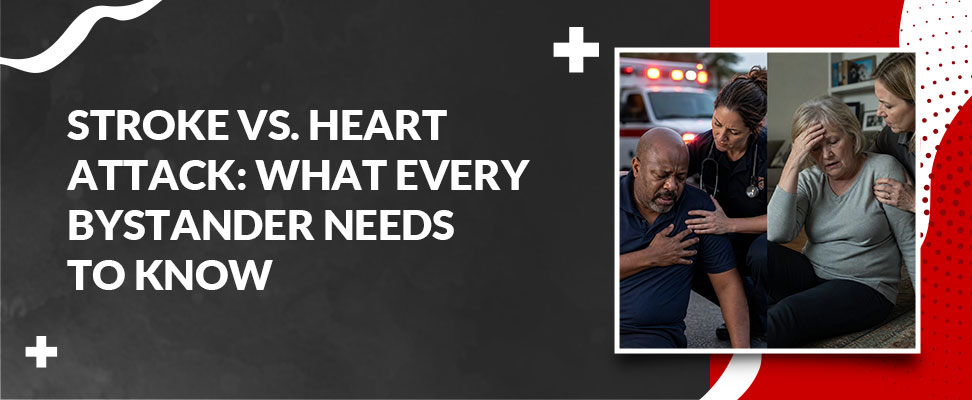
Stroke vs. Heart Attack: What Every Bystander Needs to Know
A stroke and a heart attack are both medical emergencies caused by disrupted blood supply, but they affect different organs. A heart attack cuts off blood to the heart muscle; a stroke cuts off blood to the brain. Their symptoms, treatments, and emergency responses differ. For trained bystanders, knowing which condition you are dealing with determines the actions you take next.
Key Takeaway
- Understanding the difference between a stroke and a heart attack helps bystanders recognize symptoms and respond appropriately. Both conditions require immediate emergency medical attention, as every minute can affect survival and recovery. Recognizing warning signs, noting when symptoms begin, and following emergency dispatcher instructions can save lives. Knowing when to perform CPR and why aspirin should be avoided in suspected strokes is equally important./li>
What Is a Heart Attack?
A heart attack (medically known as a myocardial infarction) happens if a coronary artery becomes blocked, most commonly by a blood clot that forms over a ruptured atherosclerotic plaque. The heart muscle supplied by that artery is starved of oxygen. Without restored blood flow, heart cells begin dying permanently within minutes.
One critical point every bystander should understand: a heart attack does not mean the heart has stopped beating. The heart continues to function, but it is being damaged by an interruption in its own blood supply. This is fundamentally different from cardiac arrest, which is addressed in a later section of this article.
Heart Attack Symptoms
Heart attacks do not always present as dramatic, movie-style chest clutching. Common symptoms include:
-
Chest discomfort: pressure, squeezing, tightness, or pain often described as "an elephant on my chest," which often pulses through the left arm, jaw, neck, or back.
-
Shortness of breath sometimes appears before chest discomfort begins.
-
Nausea, lightheadedness, or a sudden cold sweat.
-
Unusual or extreme fatigue: particularly in women, which can begin hours or days before the event.
-
Sense of impending doom or unexplained anxiety.
Some heart attacks are "silent," with no chest pain at all. People with diabetes are especially prone to atypical or minimal symptoms due to autonomic neuropathy affecting pain perception.
What Is a Stroke?
A stroke happens if blood flow to a region of the brain is interrupted. Brain cells require a constant oxygen supply and begin dying within minutes of that supply being cut off. Unlike the heart muscle, which can partially recover function, brain tissue that dies does not regenerate, making the speed of treatment even more critical.
Two Types of Stroke: Ischemic and Hemorrhagic
Ischemic strokes are usually 87% of all strokes. It is caused by a blood clot blocking an artery supplying the brain. The clot may form locally due to atherosclerosis or travel from elsewhere in the body, particularly from the heart in people with atrial fibrillation (AFib).
Hemorrhagic stroke accounts for the remaining 13% and happens due to a ruptured blood vessel bleeding into or around the brain. The resulting pressure damages the surrounding brain tissue. High blood pressure is the most common underlying trigger.
A transient ischemic attack (TIA), sometimes called a mini-stroke, has stroke-like symptoms that resolve within 24 hours. It is not minor: up to 15% of people who experience a TIA have a full stroke within three months. TIA requires emergency evaluation, not a "wait and see" approach.
Stroke Symptoms: Use BE-FAST
The BE-FAST acronym gives bystanders a reliable framework for stroke recognition:
-
B (Balance): Sudden loss of coordination or ability to walk normally.
-
E (Eyes): Sudden vision loss, blurring, or double vision in one or both eyes.
-
F (Face): Drooping on one side. Ask the person to smile- does one side fall?
-
A (Arms): Weakness in one arm. Ask them to lift up both arms- does one drift down?
-
S (Speech): Slurred, confused, absent, or strange speech. Ask them to repeat a phrase.
-
T (Time): Call 911 immediately if any signs are present. Note the exact time symptoms began.
That last point is critical: the time of symptom onset determines whether clot-dissolving medication (tPA) can be safely administered. The treatment window is 4.5 hours from the first symptom for most ischemic strokes.
Stroke vs. Heart Attack: Key Differences at a Glance
|
Organ Affected |
Heart |
Brain |
|
Primary mechanism |
Blocked coronary artery |
Blocked or ruptured brain artery |
|
Hallmark symptom |
Chest pressure / radiating pain |
Facial droop, arm weakness, speech difficulty |
|
Is the heart still beating? |
Yes, but the muscle is being damaged |
Yes, stroke does not stop the heart |
|
CPR needed at onset? |
NO, only if cardiac arrest develops |
NO, Stroke does not cause cardiac arrest |
|
AED appropriate? |
Only if cardiac arrest (VF/pulseless VT) develops |
NO, AEDs have no role in stroke |
|
Give aspirin? |
YES, chew 325mg if conscious, no allergy |
NO, dangerous if hemorrhagic stroke |
|
Clot-dissolving drug? |
Aspirin, anticoagulants, PCI procedure |
tPA within 4.5 hrs for ischemic only; NOT for hemorrhagic |
|
Treatment motto |
"Time is muscle" |
"Time is brain" |
|
Treatment time window |
Restore blood flow as fast as possible |
4.5 hrs for tPA; thrombectomy up to 24 hrs in some cases |
Shared Risk Factors
Despite affecting different organs, strokes and heart attacks share a remarkably similar set of modifiable risk factors. Reducing these risks simultaneously lowers the probability of both conditions.
-
High blood pressure (hypertension) is a crucial modifiable risk factor for both conditions. Sustained elevated pressure accelerates arterial wall damage and dramatically increases the risk of clot formation.
-
Atherosclerosis: Plaque buildup inside arterial walls narrows vessels and creates vulnerable rupture sites in both coronary and cerebral arteries.
-
Atrial fibrillation (AFib): This irregular heart rhythm causes blood to pool in the heart's chambers, forming clots that can travel to coronary arteries (causing a heart attack) or to the brain (triggering a cardioembolic stroke).
-
Diabetes: Chronically elevated blood sugar levels damage blood vessel walls and accelerate atherosclerosis throughout the cardiovascular system.
-
Smoking, high LDL cholesterol, obesity, and physical inactivity all accelerate arterial damage, promote inflammation, and increase the risk of clot formation.
Addressing these factors, particularly blood pressure control and smoking cessation, is among the most impactful steps for preventing both conditions at once.
What Should You Actually Do as a Bystander?
This is the question most medical articles do not answer, and it is the most important question for anyone with first aid or CPR training: does your response depend on whether you think it is a stroke or a heart attack?
The answer is yes, and two of the most critical differences involve aspirin and CPR. Giving aspirin incorrectly, or withholding CPR at the wrong moment, can worsen outcomes. Here is the bystander decision framework.
If You Suspect a Heart Attack
-
Call 911 immediately. Do not drive the person to the hospital- paramedics can begin life-saving intervention during transport.
-
Help the person into a comfortable position. Sitting upright with knees bent often eases breathing. Loosen any tight clothing around the chest or neck.
-
Offer aspirin if appropriate. If the person is conscious, has no known aspirin allergy, and can swallow safely, have them chew (not swallow whole) one regular 325mg aspirin. Chewing speeds absorption. This may help slow clot formation in the coronary artery.
-
Do NOT start CPR unless the person loses consciousness and stops breathing normally. A heart attack is not the same as cardiac arrest- the heart is still beating. Beginning chest compressions on a conscious patient who still has a pulse is inappropriate.
-
Be prepared to use an AED if one is nearby, but only if the person becomes unresponsive and pulseless. An AED is not used on a conscious patient.
-
Record the exact time symptoms began and report this clearly when 911 connects.
If You Suspect a Stroke
A stroke requires a different set of actions, several of which are the direct opposite of what you would do for a heart attack:
-
Call 911 immediately. The very first thing you say to the dispatcher should be the time symptoms started- this determines which treatments are available at the hospital.
-
Do not give anything by mouth. Stroke frequently impairs the swallowing reflex, making food, water, or aspirin aspirational risks. More critically, never give aspirin to a suspected stroke patient. If the stroke is hemorrhagic, aspirin can significantly worsen the bleeding.
-
Use the recovery position if the person is unconscious but breathing. Place them on their side with their head slightly tilted back to protect the airway from saliva or vomit.
-
Do NOT perform CPR unless the person is unresponsive and not breathing normally. A stroke does not stop the heart from beating.
-
Do NOT deploy an AED. An AED corrects shockable heart arrhythmias. Stroke is a brain event, and it does not produce a shockable rhythm. An AED has no therapeutic role in stroke.
-
Keep the person calm and still. Minimize movement, particularly for hemorrhagic stroke.
If You Are Unsure (And Why That Is Okay)
In the field, it is not always possible to determine within the first minutes whether someone is having a stroke or a heart attack. If you are uncertain:
-
Call 911 first, without any delay.
-
Hold aspirin unless chest pressure is the primary symptom and there are no neurological signs (facial drooping, speech difficulty, limb weakness).
-
Start CPR only if the person is unresponsive and not breathing normally. This criterion applies regardless of which condition you suspect.
-
Describe all symptoms and their onset time accurately to the dispatcher and follow their instructions precisely.
Emergency dispatchers are trained to guide bystanders through exactly this uncertainty. Your role is to call early, report accurately, and follow dispatcher guidance.
Heart Attack vs. Cardiac Arrest: Not the Same Thing
One of the most dangerous misconceptions in emergency medicine is treating "heart attack" and "cardiac arrest" as interchangeable. They are distinct events with distinct responses.
|
What is happening |
Coronary artery blocked; heart muscle losing blood supply |
Heart stops beating effectively; no blood pumped |
|
Is person conscious? |
Usually yes, at least initially |
No, sudden collapse and unresponsiveness |
|
Is the person breathing? |
Usually yes |
No or only agonal gasping |
|
Has the heart stopped? |
No |
Yes, cardiac output has ceased |
|
Is CPR needed? |
Only if cardiac arrest develops |
Yes, begin immediately |
|
Is an AED needed? |
Only if cardiac arrest develops |
Yes, deploy as fast as possible |
|
Can one lead to the other? |
Yes, heart attack can trigger ventricular fibrillation → cardiac arrest |
– |
A heart attack leads to cardiac arrest when the damaged heart muscle disrupts the organ's electrical system, producing ventricular fibrillation- a chaotic rhythm that generates no effective pumping. This escalation can occur without warning. It is the reason why calling 911 immediately at the first signs of a heart attack is so critical: the situation can deteriorate rapidly.
Can a Heart Attack Cause a Stroke?
Yes, though it occurs in a minority of cases. A heart attack degrades the heart muscle or triggers atrial fibrillation, both of which create conditions conducive to blood clot formation within the heart chambers. If a clot is dislodged and passes through the bloodstream into a cerebral artery, it can prevent blood flow to the brain, leading to a cardioembolic ischemic stroke. Research shows that stroke risk is meaningfully elevated in the first month following a heart attack, which is why anticoagulant therapy is often prescribed during cardiac recovery.
The reverse pathway is also documented. In brain regions that regulate cardiovascular autonomic function, such as the insular cortex, severe stroke can trigger a cascade of stress responses known as Stroke-Heart Syndrome. It potentially causes arrhythmias, myocardial injury, or sudden cardiac death. While both directional risks are real, they represent a minority of cases rather than the typical course.
Women's Symptoms: What May Present Differently
Both heart attack and stroke can present differently in women than in men, and these differences have historically contributed to delayed diagnosis and poorer outcomes.
Women Experiencing a Heart Attack May Have
-
Unusual or extreme fatigue, sometimes beginning days before the cardiac event itself.
-
Nausea, indigestion-like discomfort, or upper back pain rather than classic chest pressure.
-
Jaw pain, throat tightness, or shortness of breath without prominent chest symptoms.
-
A sudden, unexplained sense of anxiety or impending doom without a clear physical cause.
Women Experiencing a Stroke May Have
-
General weakness or malaise rather than clear one-sided paralysis.
-
Sudden, severe headache (especially prominent in hemorrhagic stroke).
-
Sudden confusion, agitation, or behavioral changes.
-
Hiccups or nausea are less commonly associated with stroke in public awareness materials.
Because these presentations differ from the classic descriptions most widely taught, women are statistically more likely to delay seeking emergency care. The rule for bystanders is consistent regardless of presentation: if something feels suddenly and inexplicably wrong, especially in someone with known cardiovascular risk factors, call 911 immediately and let emergency professionals evaluate.

QUICK Q&A
What is the main difference between a stroke and a heart attack?
A heart attack happens if the blood flow to the heart muscle gets blocked- the heart continues beating, but is being damaged. A stroke happens when blood flow to the brain is interrupted or a blood vessel ruptures. The organ affected determines the symptoms: chest pressure for a heart attack; facial drooping, arm weakness, and speech difficulty for a stroke. Both are life-threatening emergencies requiring immediate 911 calls.
Is cardiac arrest the same as a heart attack?
No, they are distinct events. A heart attack is a circulation problem: the heart is still beating, but part of the muscle is being starved of oxygen because a blood vessel is blocked. Cardiac arrest is an electrical event that occurs when a blood vessel is blocked, which stops the heart from beating effectively and results in no blood flow. CPR and AEDs are used for cardiac arrest, not for a heart attack unless a heart attack escalates into cardiac arrest, which can happen without warning.
Should you do CPR on someone having a heart attack?
Not unless cardiac arrest has developed, meaning the person has become unresponsive and is not breathing normally. A heart attack alone does not stop the heart. Performing chest compressions on a conscious person who still has a pulse is not appropriate and can cause harm. Call 911 immediately, keep the person calm, have them chew an aspirin if appropriate, and monitor closely for any deterioration.
Do you use an AED for a stroke?
No. An automated external defibrillator is designed to treat life-threatening heart arrhythmias like pulseless ventricular tachycardia. Stroke is a brain event caused by an interrupted blood supply or hemorrhage, and it does not involve a shockable heart rhythm. Deploying an AED on a stroke patient would be ineffective and delay appropriate care. The correct response is to call 911 and note the time of symptom onset.
Can you call aspirin for a suspected stroke?
No, not in the field. For a heart attack, aspirin helps slow clot formation in the coronary artery and is recommended if the person is conscious and has no allergy. For a suspected stroke, giving aspirin before imaging is dangerous: approximately 13% of strokes are hemorrhagic, and aspirin can significantly worsen hemorrhagic bleeding. Only hospital CT or MRI imaging can confirm the stroke type. Never give aspirin to someone showing stroke symptoms.
Can a heart attack cause a stroke?
Yes, in some cases. A heart attack can damage the heart muscle or trigger atrial fibrillation, creating conditions where blood clots form inside the heart chambers. If a clot travels from the heart to the brain, it causes a cardioembolic ischemic stroke. The risk of stroke is elevated in the weeks following a heart attack, which is one reason cardiac recovery protocols often include anticoagulant therapy prescribed by the treating cardiologist.
Which is more serious: a stroke or a heart attack?
Both are immediately life-threatening, and comparing severity depends on the individual event and speed of treatment. Heart attacks claim approximately 700,000 American lives each year and are the leading cause of death in the US. However, stroke survivors are more likely to experience lasting disability, including permanent speech, mobility, and cognitive impairments. In both cases, time from symptom onset to treatment is the single largest determinant of outcome.
How long before a stroke causes permanent brain damage?
Brain cells begin dying within minutes of losing oxygen. Estimates suggest approximately 1.9 million brain cells are lost every minute a large-vessel ischemic stroke goes untreated. Clot-dissolving medication (tPA) must be given within 4.5 hours of symptom onset to be effective for most patients. Mechanical thrombectomy, a procedure that physically removes the clot, can extend that window up to 24 hours in select cases. Every minute of delay narrows options and worsens outcomes.
Related Posts

NCAA Amends CPR Rules
Style Snapshot The NCAA has updated its rules to require that a CPR-certified staff member must be present during physical countable athletic activities on campus. While it is not mandatory for coaches to be certified, it is encouraged to ensure safety during emergencies. This change empowers coaches to respond effectively in catastrophic situations. Surprisingly, college […]

CPR for Pregnant Women- Step-by-Step Guide to Safe Maternal Resuscitation
Maternal cardiac arrest is a rare but life-threatening emergency that requires immediate and specialized care. The incidence is approximately 1 in every 12,000 deliveries, according to the American Heart Association (AHA). While uncommon, this statistic highlights the critical need for healthcare providers and bystanders to be prepared. The most common causes include hemorrhage, cardiovascular disease, […]

Wife Saves Husband with CPR
“I think everyone should take a CPR class and become certified,” said Joan Hager. Hager’s husband suffered a heart attack after performing physical activity, and Hager immediately recalled her CPR training from 20 years prior. “Anything can happen at any time – not just at home but also at the grocery or in the community. […]
What is the Difference Between BLS (Basic Life Support) CPR and Heartsaver CPR?
Style Snapshot Understanding the differences between BLS (Basic Life Support) CPR and Heartsaver CPR helps you select the right training for your needs. BLS CPR is designed for healthcare professionals, covering advanced life-saving techniques, while Heartsaver CPR caters to the general public, offering essential skills like basic CPR, AED use, and first aid. Both certifications […]

CPR Device Saves Life
The Lucas CPR Device is getting around, joining a growing list of CPR success stories like the one where a seven-year-old learned CPR from YouTube and saved her mom’s life. A Texas fire department has equipped all their ambulances with the life-saving tool. Style Snapshot The Lucas CPR Device is revolutionizing emergency response by delivering […]
CPR or BLS Certification? How to Choose the Ideal CPR Class
If you are in the healthcare field, then you know that part of your job is to be certified in CPR. But with so many different classes and options available, how do you choose the ideal CPR class for you? Here are a few things to consider when making your decision. What Type Of Certification […]