




CPR vs BLS: Understanding the Key Differences
This article clarifies the distinctions between Cardiopulmonary Resuscitation (CPR) and Basic Life Support (BLS), emphasizing that while both are life-saving techniques, BLS encompasses CPR along with additional skills and tools tailored for healthcare professionals. Understanding these differences is crucial for selecting the appropriate training based on one's role and responsibilities.
Knowing how to differentiate between life and death in a medical emergency. Two commonly mentioned terms in emergency response training are CPR (Cardiopulmonary Resuscitation) and BLS (Basic Life Support). While often used interchangeably, they refer to different levels of training and care. Understanding the key differences between CPR and BLS is essential for healthcare professionals and the general public.
As per Sudden Cardiac Arrest Foundation, nearly 400,000 out-of-hospital heart attack happen annually in the U.S. This statistic underscores the prevalence of cardiac emergencies and the importance of being prepared. Whether you’re a bystander looking to assist or a medical professional delivering care, knowing when to apply CPR or BLS can save lives.
This article explains what sets CPR apart from BLS, who needs which training, and how each contributes to better emergency outcomes.
What is CPR?
Understanding CPR is the first step in recognizing how it differs from more advanced emergency care techniques like BLS. In the CPR vs BLS comparison, CPR refers to a foundational life-saving procedure anyone can learn and perform. While BLS includes CPR, the two serve different purposes depending on training level and situation. This section will help you understand the scope of cardiopulmonary resuscitation, when it should be used, and how it is performed.
Definition of CPR
Cardiopulmonary resuscitation (CPR) is done if a person’s heart stops beating or they stop breathing. It is a combination of chest compressions with rescue breaths that enable blood and oxygen circulating to vital organs. In the BLS versus CPR discussion, CPR is the core technique taught to laypersons and professionals. Learning CPR is critical because quick action can save lives. CPR statistics show its importance in increasing survival chances.
When to use CPR
CPR is performed if a person is unresponsive, not breathing, or only gasping. These situations often include drowning, sudden cardiac arrest, or choking. Lay rescuers are typically the first on scene, so knowing when to act is essential. In the CPR vs. BLS debate, most bystanders perform CPR before help arrives. Bystander CPR can double or triple survival chances—a powerful reason for the public to learn this vital skill.
Types of CPR
CPR includes chest compressions and rescue breaths (30:2 ratio), and hands-only CPR, which involves chest compressions only. Hands-only CPR is recommended for untrained bystanders. While both types are effective, choosing the right one depends on the rescuer’s training and comfort level. Many CPR myths suggest breaths aren’t needed, but conventional CPR remains essential for infants and children in respiratory arrest.
CPR steps for laypersons
Laypersons should follow the 30:2 compression-to-ventilation cycle: 30 chest compressions that get followed with two rescue breaths. Start by checking responsiveness and breathing, then call 911 or ask someone to do so. Start chest compressions strongly and fast in the center of the chest, followed by breaths if trained. Repeat the cycle until help arrives. Despite clear steps, less than 20% of Americans are trained to perform CPR, showing a significant gap in preparedness.
What is BLS?
While CPR is widely taught to the general public, Basic Life Support (BLS) is designed for healthcare professionals and trained responders. In the CPR vs BLS comparison, BLS represents a more advanced and comprehensive skill set. It includes CPR as one of its elements but incorporates tools and techniques that improve patient outcomes. This section explains how BLS versus CPR training differs and what makes BLS essential in clinical and emergency settings.
Definition of BLS
Basic Life Support (BLS) refers to the level of medical care used to sustain life in emergencies until complete medical treatment can be given. It includes recognizing cardiac arrest, initiating high-quality CPR, and using equipment like an automated external defibrillator (AED). In the context of BLS versus CPR, BLS is more advanced and is part of professional emergency care. It equips responders to handle complex scenarios requiring quick, skilled intervention.
Components of BLS training
BLS components include several critical procedures: AED use, airway management, rescue breathing, and using a bag-valve-mask. These tools allow BLS providers to assist patients more effectively than CPR alone. Airway management and proper ventilation are emphasized, helping ensure oxygen delivery to the brain. The BLS provider course prepares professionals to perform these tasks confidently, often in high-pressure environments. These core components are what differentiate basic life support from layperson CPR.
BLS providers
BLS providers include healthcare workers such as nurses, EMTs, paramedics, doctors, and trained first responders. They are expected to perform CPR using advanced tools and techniques not typically used by the general public. In the CPR vs. BLS framework, BLS providers have the training to manage more complex emergencies.
Certification names
Two leading organizations offer basic life support certification: the American Heart Association’s AHA BLS Provider and the Red Cross BLS certification. While both cover similar content, they may differ in teaching format and assessment methods. Both are widely recognized in healthcare settings and meet professional training requirements. Anyone pursuing a BLS provider course should ensure the certification aligns with workplace needs and regulatory standards.
Key Differences Between CPR and BLS
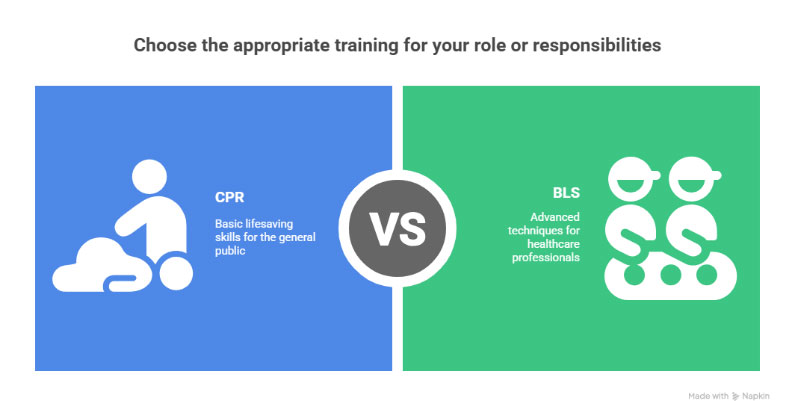
Although CPR and BLS share a common goal—saving lives during cardiac and respiratory emergencies—they are not identical. Understanding the difference between BLS and CPR is essential when choosing the proper training for your role or responsibilities. Questions like “Is CPR certification the same as BLS?” or “Is BLS the same as CPR?” often arise. This section breaks down the distinctions in audience, techniques, equipment, and protocols to clarify the comparison between CPR and BLS.
Primary audience
CPR is designed for the general public, including teachers, coaches, and family members who may witness a sudden emergency. In contrast, BLS is intended for trained healthcare professionals. In the BLS versus CPR comparison, audience differences are apparent: BLS requires a higher medical understanding. Whether you’re comparing ACLS vs BLS or PALS vs BLS, each builds on BLS fundamentals tailored to specific populations or roles.
Scope of training & techniques
CPR training focuses on basic lifesaving actions such as chest compressions and rescue breaths, typically for a single-rescuer situation. BLS goes further, training responders for team-based care, coordinated roles, and advanced decision-making. This difference between BLS and CPR makes BLS better suited for hospital or emergency response environments. If you’re considering training options, the scope of CPR vs BLS can help guide your decision based on your responsibilities.
Equipment & airway management
In standard CPR courses, laypersons learn to use an AED (automated external defibrillator) and perform mouth-to-mouth breaths. BLS includes this but adds tools like the bag-valve-mask (BVM) and advanced airway devices. These additions enable more effective oxygenation and ventilation. The difference between BLS and CPR is clear in clinical settings where equipment plays a crucial role. For professionals, BLS bridges the gap between CPR and more advanced care like ACLS.
Assessment protocols
CPR emphasizes checking for responsiveness and normal breathing. BLS, however, includes more detailed assessments such as checking for a carotid pulse, monitoring vital signs, and using structured protocols to determine the next steps. This reflects a deeper understanding of patient conditions and clinical decision-making. When asking, “Is CPR certification the same as BLS?” remember that BLS training covers far more than just basic assessments—another reason it’s essential for medical personnel.
Similarities Between CPR and BLS
Despite their differences, CPR and BLS share many significant similarities. Both are designed to save lives by responding quickly and effectively during emergencies. The core procedures in each—chest compressions, rescue breathing, and use of an AED—are based on the same evidence-based guidelines from the American Heart Association (AHA). Whether performed by a layperson or a trained medical professional, the goal is to restore circulation and breathing as soon as possible.
Another key similarity is the emphasis on the Chain of Survival, which outlines the steps needed to improve survival rates after cardiac arrest. These include early recognition, immediate CPR, rapid defibrillation, effective advanced care, and post-resuscitation support. Both CPR and BLS stress the importance of each link in this chain.
Furthermore, both training programs work to correct CPR myths, such as the idea that mouth-to-mouth is always required or that you could harm someone by doing CPR incorrectly. Both certifications also teach the importance of scene safety, activating emergency services, and staying calm under pressure.
In short, while CPR vs BLS training may differ in complexity, they are united by the same life-saving mission and standardized practices vital in any emergency.
Recertification requirements for CPR and BLS
Both CPR and BLS certifications come with expiration dates, emphasizing the need for regular renewal to maintain readiness and confidence. For most providers, CPR certification is valid for two years, and recertification involves taking a refresher course or a whole class, depending on the certifying organization’s policies. This ensures that rescuers stay up to date with current CPR statistics and updated guidelines.
BLS certification also typically remains valid for two years, but may have stricter recertification requirements, especially in medical and clinical settings. To renew BLS, participants must complete a BLS provider course or a recognized refresher program. Healthcare facilities often require BLS certification to be current and may not accept expired credentials, highlighting the importance of timely renewal.
Recertification also reminds us that protocols and best practices can change. With advancements in resuscitation science, organizations like the AHA and Red Cross BLS programs periodically update CPR and BLS guidelines.
In both cases, continuing education plays a crucial role. Whether you’re a layperson or a professional, staying certified keeps your skills sharp and ensures you’re ready to act when every second counts.
Choosing the proper certification: CPR vs BLS
When deciding between CPR vs BLS certification, your career path, job requirements, and personal readiness should guide your choice. Standard CPR training is sufficient if you’re a teacher, coach, parent, or community volunteer. It prepares you to handle emergencies like choking or sudden cardiac arrest until professional help arrives. CPR courses are designed to be accessible, often completed in a few hours, and do not require prior medical knowledge.
On the other hand, if you’re entering or already working in healthcare—as a nurse, EMT, or hospital technician—you’ll need Basic Life Support (BLS) certification. The BLS provider course goes beyond standard CPR by teaching team-based response strategies, airway management, and advanced equipment use. BLS is a job requirement in many clinical environments and is the foundation for further training, like ACLS vs BLS or PALS vs BLS certifications.
It’s also important to consider how comfortable you feel in emergencies. BLS offers more comprehensive instruction if you’re confident and want to deepen your skills. When comparing BLS versus CPR, the key is choosing the certification which is best suited for your role and the level of responsibility you’re prepared to take on during a crisis.
Beyond BLS: Advanced Life Support Certifications
Once you’ve mastered the fundamentals of CPR and BLS, advanced certifications are available for healthcare professionals who need to manage more complex emergencies. These courses help with learning Basic Life Support (BLS) and focus on specialized care in critical situations. Suppose you’re comparing ACLS vs BLS or PALS vs BLS. In that case, it’s essential to understand that advanced certifications are designed for professionals involved in direct patient care in hospitals or emergency settings. They require a solid foundation in BLS and clinical decision-making.
ACLS (Advanced Cardiovascular Life Support)
Advanced Cardiovascular Life Support (ACLS) training program is for healthcare professionals who handle cardiac and respiratory emergencies in adults. It covers advanced airway management, reading electrocardiograms (ECGs), and administering emergency medications. Unlike BLS, which focuses on immediate response, ACLS emphasizes diagnosis, treatment protocols, and team dynamics in critical care. This certification is required for paramedics, physicians, and ICU nurses. ACLS vs BLS highlights the move from basic response to clinical decision-making and leadership in resuscitation efforts, making it essential for those working in emergency departments or critical care units.
PALS (Pediatric Advanced Life Support)
Pediatric Advanced Life Support (PALS) focuses on emergency care for infants and children. It is designed for pediatricians, emergency nurses, and other healthcare providers who treat young patients. PALS training includes pediatric assessment, airway and breathing support, rhythm recognition, and managing shock and cardiac arrest in children. This course builds on BLS by addressing the unique needs of pediatric patients. In the PALS vs BLS comparison, PALS offers more specialized training and is often required in pediatric intensive care units and emergency settings where timely, child-specific care is essential.
Wrapping up
Understanding the difference between CPR and BLS is crucial when choosing the proper life-saving certification. While CPR equips laypersons to respond effectively in emergencies, BLS is designed for professionals who require advanced training and teamwork skills. Both play a vital role in improving survival outcomes during cardiac events. Whether you need CPR for basic preparedness or BLS for a healthcare role, timely training can save lives.
Take the first step today—enroll in a Simple CPR course to get certified or renew your credentials. Be prepared, stay confident, and help make a life-saving difference in your community.
FAQ
Is BLS the same as CPR?
No, BLS is not the same as CPR. BLS (Basic Life Support) includes all CPR skills but covers advanced techniques like team-based care, airway management, and equipment such as bag-valve masks. It is designed specifically for healthcare providers and first responders.
Do I need a CPR certification if I have a BLS?
You do not need a separate CPR certification if you hold a valid BLS certification. BLS covers all the necessary CPR skills and is accepted by most employers and institutions as meeting CPR training requirements for both lay and professional settings.
What is higher than BLS certification?
Certifications like ACLS (Advanced Cardiovascular Life Support) and PALS (Pediatric Advanced Life Support) go beyond BLS. These advanced courses are designed for healthcare professionals managing complex emergencies, including cardiac arrest in adults (ACLS) and children (PALS), and require a current BLS certification.
What does BLS stand for?
BLS stands for Basic Life Support. The certification course teaches healthcare providers how to recognize life-threatening emergencies, perform high-quality CPR, use an AED, and manage airways—all critical during cardiac and respiratory arrest.
What are the two types of BLS?
The two main techniques under BLS protocols are hands-only CPR. They involve chest compressions only, and conventional CPR, which includes compressions and rescue breaths. The choice depends on the rescuer’s training and the situation, especially in adult versus pediatric emergencies.
What are the five steps of BLS?
The five basic steps of BLS are to ensure scene safety, check for responsiveness and breathing, activate emergency medical services (EMS) and get an AED, check for a pulse (if trained), and begin high-quality CPR with the correct compression depth and rate to maintain circulation.


Related Posts

CPR Saves Drowning Child
Children are attracted to the water like a magnet to the North Pole, and sadly, summer time gives rise to many unnecessary drowning deaths. Besides always making sure your child can swim, and wears a life vest, knowing CPR can reverse a horrible accident. Last week, a little boy was found in a retention pond. […]
COOL CPR TOOL
It’s a step by step instruction guide for CPR. On the spot! The little red wheel-looking gadget almost looks like a toy. But it may just be the next best thing to learning CPR. This new medical device takes the guesswork out of CPR, and puts power in the hands of those ready to offer […]

Firefighter Breathes Life Into Chihuahua
Capt. Scott Ledet forced his way into the burning RV with a hatchet. He found Pony, a 1-year-old Chihuahua in her crate, lifeless. He whisked her outside and began mouth-to-mouth. Yep, that’s right. He spread her mouth open and put his lips “down to the bottom of her throat.” Ledet didn’t let up, and after […]
Be a CPR Hero & Save a Life
Even if you don’t need to get CPR or First Aid certified for work, it’s such an important skill to learn for many other reasons. The biggest threats to our loved ones are heart attacks and accidents, responsible for taking a life every 34 seconds. Did you know that a person can survive for four […]
Lightening Strike Kills Boy; CPR Brings Him Back to Life
He was technically dead.His heart had stopped beating.His clothes were burning. And two bystanders started CPR on the 12-year-old boy, saving his life. Today, Ken Nilson is a firefighter in Bremerton, Washington. “It was an experience that would profoundly change my life forever,” explains Nilson. He makes it a point to teach young children ways […]
How to Get CPR AED Certification in 60 Minutes or Less
Time—there never seems to be enough of it in a day to get everything done. But some things, such as CPR and first aid certification, are best taken at a more careful pace. After all, you want to make sure you’re learning how to perform these lifesaving skills correctly. Believe it or not, you can […]